· by max
what is sound design: from a wave to your own sound
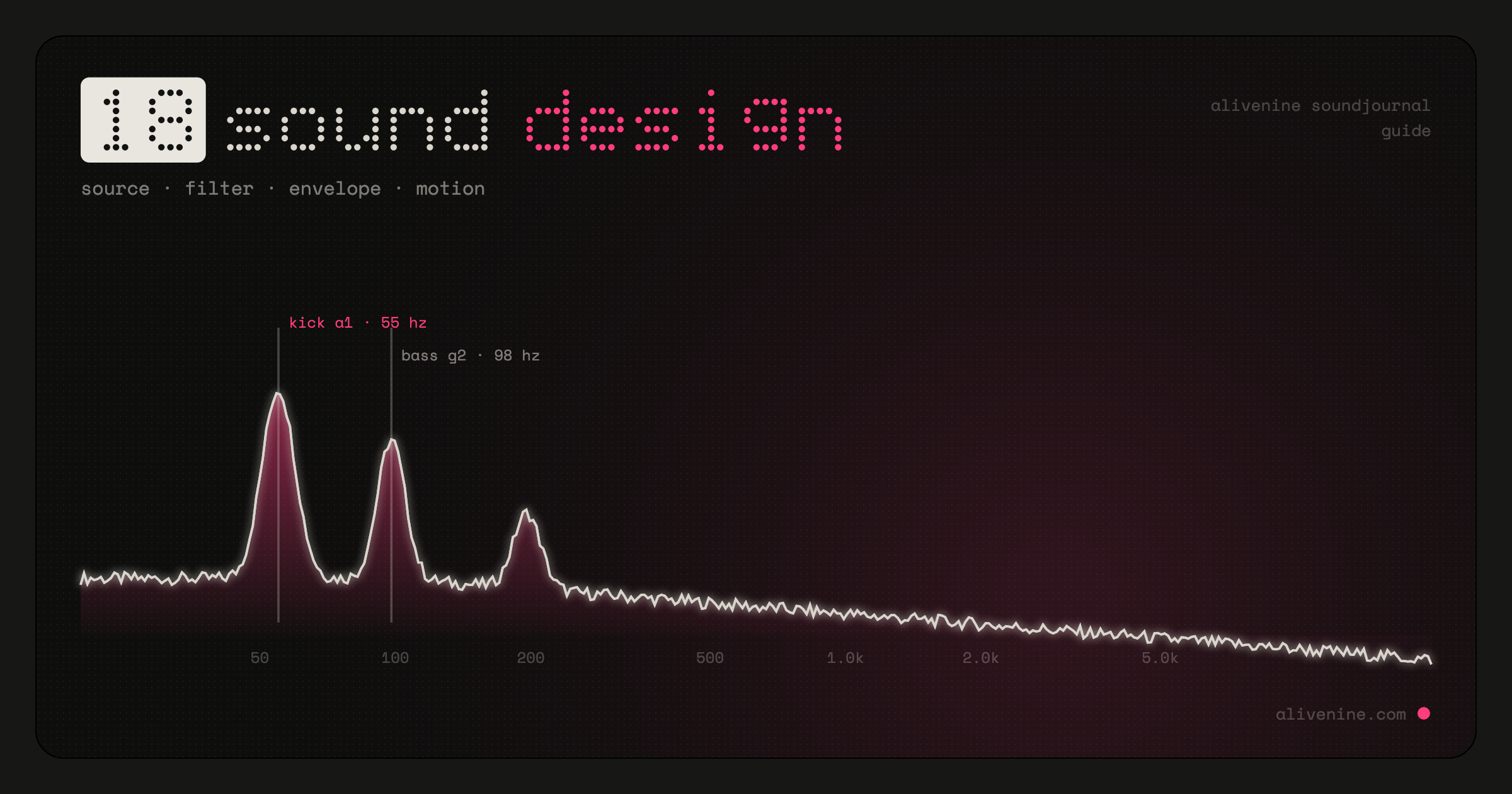
Sound design means deciding what a sound is made of. In music that usually happens on a synth or a sampler: you pick a source, take away what you don't need, give it a shape in time and let something move it. Every kick, every pad and every lead you like went through those steps, by hand or by preset. Once you know what each step changes in the air, you can build almost any sound on purpose instead of scrolling for it.
- sound is air pressure moving back and forth. how often it repeats is the pitch, how far it swings is the level.
- timbre is two things: the partials and how they change over time. cut off the start of a piano note and it gets hard to tell it's a piano.
- most sound design follows one chain: source, filter, envelopes, modulation, effects.
- three sounds teach most of it: a kick from a sine, a wide pad from two saws, a hat from noise.
- listen in the track. a sound that is perfect alone is often too big once the rest plays.
what sound is
A speaker cone pushes the air in front of it, pulls back and pushes again. The air molecules pass that movement on, and a few milliseconds later your eardrum moves the same way. That moving pressure is sound. At room temperature it travels at about 343 metres per second.
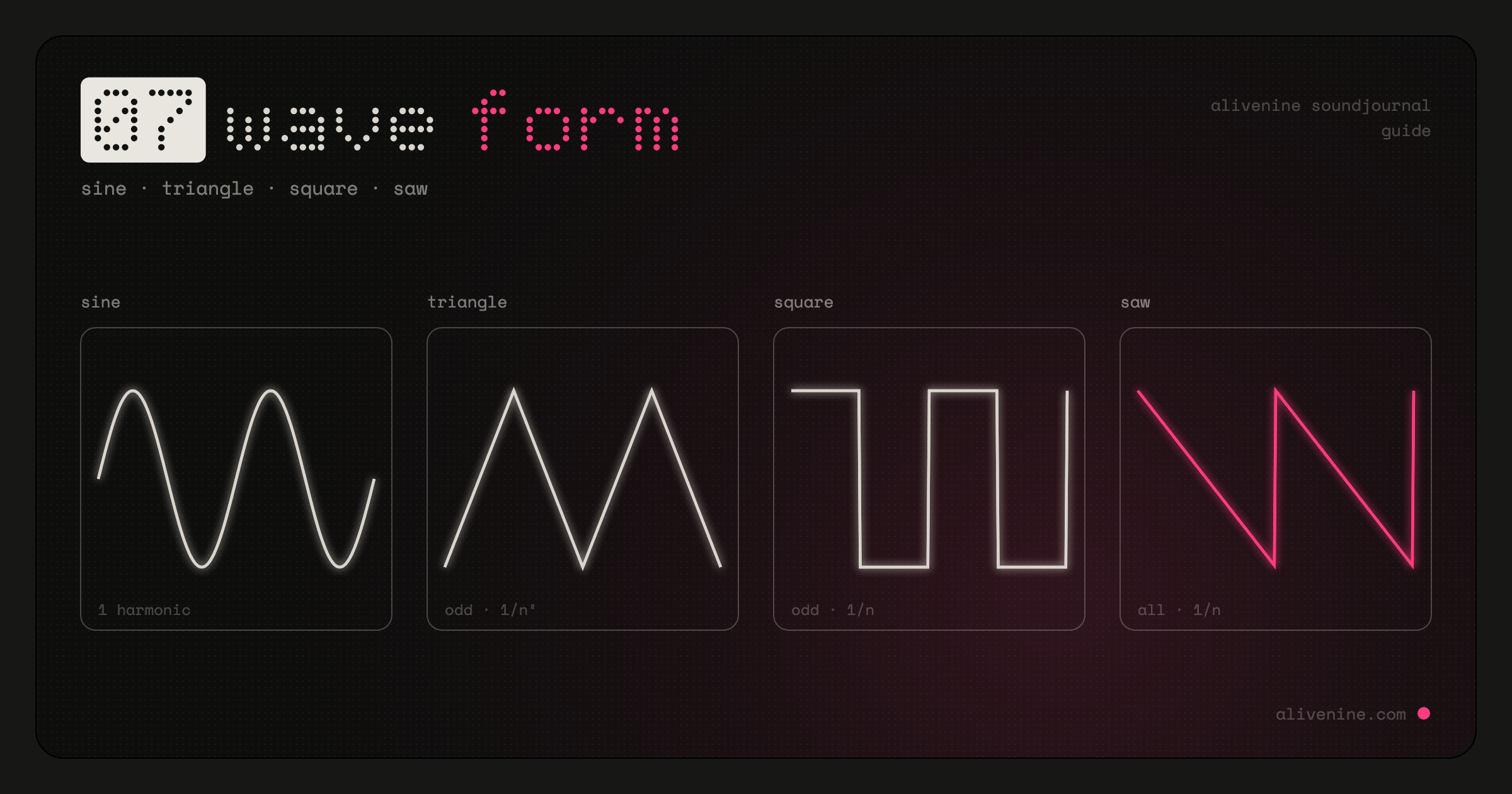
Drawn over time, the movement becomes a wave. Time runs left to right, pressure up and down. A DAW shows the same picture when you zoom into a recording. What is a waveform goes deep on the four classic shapes. Here it's enough to know that every sound you hear can be described by three things: how often the wave repeats, how far it swings, and what it looks like.
The wavelength explains a lot in a studio. A 50 Hz tone is almost seven metres long. A 5 kHz tone is under seven centimetres. That's why low end fills a room and builds up in corners, while the top end is easy to block with a pillow or a turned head.
pitch and level
Frequency is the number of repeats per second, measured in hertz. We hear it as pitch. Humans hear from about 20 Hz to 20 kHz, and the top shrinks with age. The A above middle C is tuned to 440 Hz in most music today.
Pitch works in ratios. An octave up doubles the frequency: 110, 220, 440, 880 Hz are all A. The twelve semitones in between split that doubling into equal steps, each about 6 percent higher than the last. A cent is a hundredth of a semitone. That's the unit you see on fine tune and detune knobs.
| Range | Roughly | What lives there |
|---|---|---|
| Sub | 20 to 60 Hz | The weight of a kick and a sub bass, felt more than heard |
| Low | 60 to 250 Hz | The body of bass, kick and the lowest notes of chords |
| Low mids | 250 to 500 Hz | Warmth, and mud when too many things meet |
| Mids | 500 Hz to 2 kHz | The core of voices, guitars and most synth leads |
| Upper mids | 2 to 6 kHz | Presence, attack, the part the ear is most sensitive to |
| Top | 6 to 20 kHz | Air, cymbals, breath and hiss |
Amplitude is how far the wave swings. We hear it as loudness, on a log scale. Doubling the amplitude adds about 6 dB. It takes roughly 10 dB more before most people say something sounds twice as loud. That's why small level moves of one or two dB matter in a mix, and why a louder version of a sound almost always seems better at first. Compare sounds at the same level, or the louder one wins.
timbre: partials and time
A flute and a violin can play the same note at the same level and you still know which is which. The difference is called timbre, and it comes from two places.
the partials
Almost no sound is a single frequency. A note on a string vibrates at its fundamental and, at the same time, at two, three, four times that frequency and so on. Those are the harmonics, and together they form the harmonic series. How strong each one is gives the sound its colour. Many harmonics high up sound bright and buzzy. Few sound round and soft.
Some sounds have partials that don't sit on that series. Bells, metal plates, many drums and cymbals are full of them. That's why they sound like a strike instead of a note, and why a bell can seem to have two pitches at once. The general word for all of these components is partials. Harmonics are the partials that line up in whole number steps.
the shape in time
The second half of timbre is change. A piano note starts with a hard hit full of high partials, then the top fades faster than the bottom. A string section swells in slowly. A pluck is bright for a moment and then dull. If you cut away the first tenth of a second of a recorded instrument, many people can no longer name it.
So a sound is a spectrum that moves. Sound design is deciding what that spectrum is at the start, what it does over the next second, and what keeps it moving after that.
the chain every sound goes through
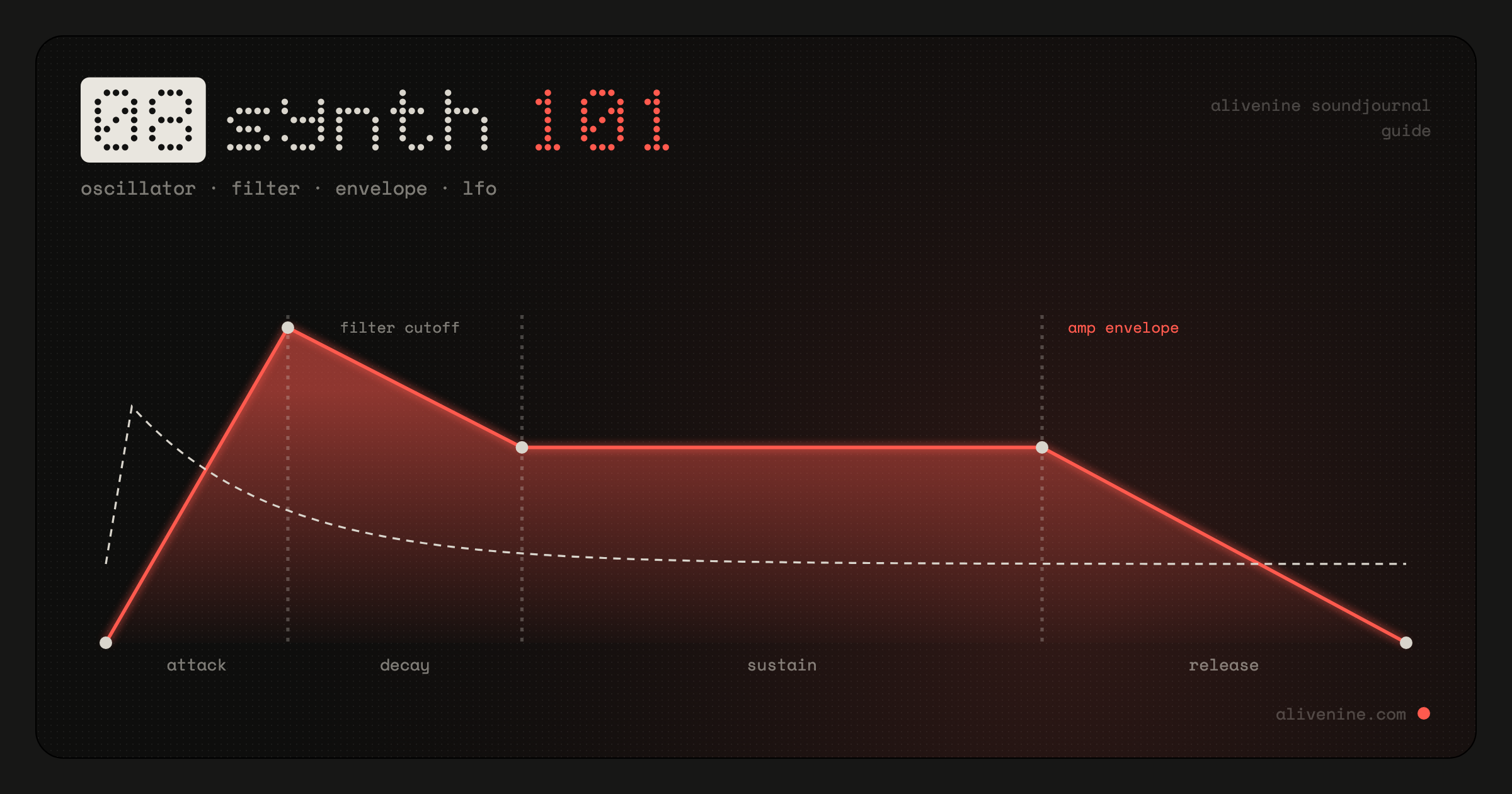
Synths look different, but nearly all of them follow the same path. How to use a synthesizer walks through every knob. This is the short version, as a way to think.
| Step | What it decides | Typical controls |
|---|---|---|
| Source | The raw material and its partials | Wave shape, sample, noise, detune, octave |
| Filter | Which partials stay | Cutoff, resonance, slope, drive |
| Envelopes | How level and colour change after each note | Attack, decay, sustain, release, amount |
| Modulation | What keeps moving while the note holds | LFO rate and amount, velocity, mod wheel |
| Effects | The space and the surface around the sound | Saturation, chorus, delay, reverb |
The order matters because each step can only work with what the one before gives it. A filter can't add partials that the source doesn't have. A reverb can't make a thin sound full. When a sound isn't working, go back to the source first. A lot of time is lost turning effect knobs on a sound whose problem is the wave.
Envelopes are where a sound gets its character. An envelope is a shape in time that starts on every note: attack, decay, sustain, release. Sent to the level, it decides whether a sound hits or swells. Sent to the filter, it decides whether a sound opens and closes. Sent to the pitch, it can turn a sine into a kick, as you'll hear below.
Modulation is what stops a sound from standing still. An LFO slowly moving the cutoff, a little random drift on the pitch, velocity opening the filter when you play harder. Real instruments never repeat exactly, and a sound with nothing moving inside it quickly starts to sound like a computer. How to make soft synths sound analog is about exactly that.
five ways to make a sound
Synthesis types differ in the source and in how they get to the partials. Each is good at something. None is better in general.
| Type | How it works | Good at | Harder for |
|---|---|---|---|
| Subtractive | Start with a wave full of partials, filter them away | Basses, pads, leads, warm classic sounds | Bells, metallic and very complex tones |
| FM | One oscillator changes the frequency of another very fast, which creates new partials | Bells, electric pianos, hard basses, metal | Predicting the result from the knobs |
| Wavetable | A row of single cycles, and a position control moves through them | Sounds that change shape over time, modern basses | Sounding soft and simple |
| Granular | Cuts a sample into tiny grains, usually 1 to 100 ms, and plays them back in clouds | Textures, frozen moments, ambient beds | Tight, punchy rhythm sounds |
| Sampling | Plays back a recording, often tuned across the keys | Real instruments, found sounds, the character of a moment | Shaping the sound deep inside after recording |
In practice they mix. A wavetable synth usually has a filter. A sampler usually has envelopes and LFOs. The chain from above still applies. Only the source changes.
three sounds to build
Any synth with one oscillator, a filter, two envelopes and a noise source will do. The synths that come with Ableton Live and Logic Pro have all of it. Build each sound once from an empty patch and you'll know more than from a hundred presets.
1 · a kick from a sine
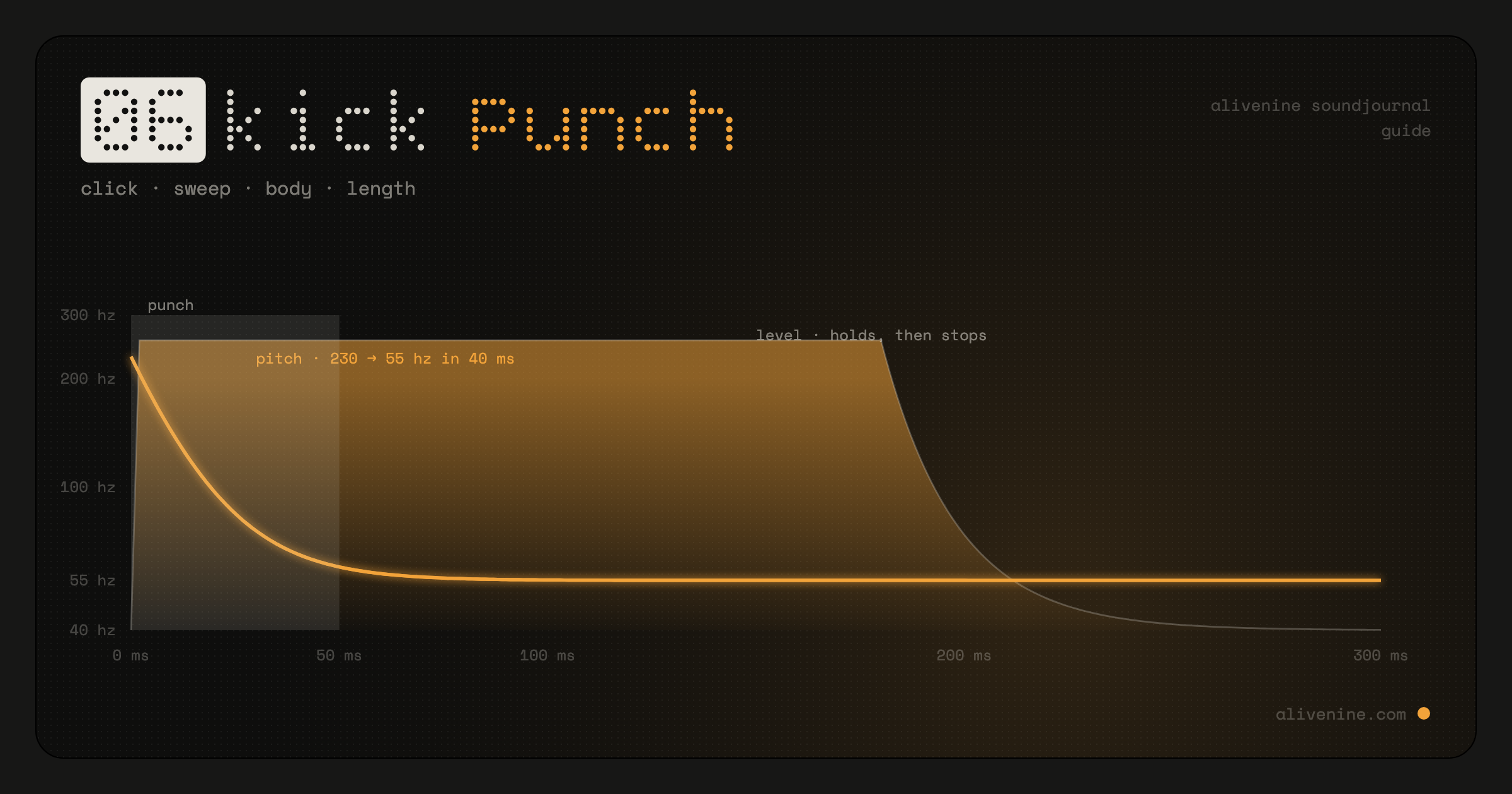
This one shows how much a pitch envelope does.
- One oscillator, sine wave. Filter fully open or off.
- Pitch of the oscillator: the body note, somewhere around 45 to 60 Hz.
- A pitch envelope with zero attack and a decay of 30 to 50 ms. Set the amount so the note starts about two octaves higher and falls down to the body.
- The amp envelope: zero attack, decay of 200 to 400 ms, sustain at zero.
- Play it slowly. Then move only the pitch decay. Under 20 ms it turns into a click, over 80 ms it starts to sound like a laser.
The falling pitch is what you feel as punch. How to make a kick drum punchy covers click, length and the mix, and how to tune your kick to the key shows how to pick the body note.
2 · a wide pad from two saws
This one shows what happens when two partials sit very close.
- Two oscillators, both saw, same octave.
- Detune the second by 7 to 12 cents. At 440 Hz, 7 cents apart means the two waves drift in and out of phase almost twice per second. You hear that as a slow, wide shimmer.
- Lowpass filter around 1.5 to 3 kHz, resonance low.
- Amp envelope: attack 300 ms to 1 s, sustain high, release 1 to 3 s.
- A slow LFO, around 0.1 to 0.3 Hz, moving the cutoff a little.
- Play a chord in the middle of the keyboard and hold it.
Take the detune back to zero and the width collapses into one flat saw. That difference is why almost every big synth sound uses more than one voice per note.
3 · a hat from noise
This one shows a source with no pitch at all.
- Switch the oscillators off and turn up the noise source. White noise has equal energy per hertz, so most of what you hear is high.
- Highpass filter around 6 to 9 kHz.
- Amp envelope: zero attack, decay 30 to 80 ms for a closed hat, 300 to 600 ms for an open one, sustain at zero.
- Map velocity to the level, and play a pattern of sixteenth notes with uneven velocities.
The uneven velocities make it groove. What is a step sequencer shows how to program the pattern, with accents and swing.
sound design for a track
A sound is only finished in the song. A pad that sounds huge alone fills the space the vocal needs. A bass with lots of low end on its own fights the kick. Three habits help.
- Design in context. Build the sound while the drums and the bass play, at the level it will sit.
- Give each sound a range. The table under pitch and level is a good map. The kick and the bass share the low end, so they take turns. The voice owns the mids. Pads go where nothing else is.
- Leave one thing moving. A little drift, a slow filter, a velocity change. A sound that moves a bit is easier to listen to for three minutes.
For the low end, a bass that leaves room for the kick and the vocal shows how to split a bass and keep the low mids clear.
where to go from here
This article is the start of a series. Each of the following goes deeper on one step:
- What is a waveform: the four shapes and their harmonics.
- How to use a synthesizer: every section of a synth, with settings for a pad, a pluck, a bass and a lead.
- How to make a kick drum punchy: click, sweep and body.
- How to make soft synths sound analog: drift, detune, drive and tape.
- How to make a bassline: notes and rhythm once the sound is ready.
- What is a step sequencer: putting it all in time.
I build the alivetools from the wave up, the same way: the drums in alivedrum are synthesized live from oscillators and noise, and the chords in alivesynth come from oscillators, drift and pitch tuned to each other. You can play alivesynth in the browser with the real plugin code, and alivemeter, which is free, shows the waveform and the spectrum of anything you build, with the note and cents under the cursor.
faq
What is sound design in music?
Sound design is building and shaping the sounds a track is made of: choosing a source like a wave, a sample or noise, filtering it, giving it a shape in time with envelopes, adding movement and effects. In electronic music it mostly happens on synths and samplers.
What is a sound wave in music?
A sound wave is air pressure moving back and forth. How many times per second it repeats is the pitch, how far it swings is the level, and its shape, made of partials, is the colour of the sound.
What makes two sounds with the same note sound different?
Their timbre. It comes from which partials the sound has and how strong they are, and from how the sound changes over time, especially in the first fraction of a second.
What is the difference between harmonics and partials?
Partials are all the frequencies in a sound. Harmonics are the partials at whole number multiples of the fundamental. Strings and winds are mostly harmonic, bells and many drums have partials that are not.
Which type of synthesis should a beginner learn first?
Subtractive synthesis. It has the clearest chain, wave, filter, envelope, and almost every other kind of synth uses the same controls on top of its own source.
Do I need expensive gear for sound design?
No. The synths that come with Ableton Live and Logic Pro have everything in this article. Good headphones or speakers and a quiet room matter more than any plugin.
Start with the kick from a sine. It takes five minutes and shows you more about envelopes than any diagram. Then build the pad and the hat, and put all three in one loop.