· by max
what is a waveform in music: sine, saw, square and triangle
A waveform is the shape of a sound drawn over time. Two sounds can have the same pitch and the same loudness and still sound different. Most of that difference is in the shape. On a synth you choose that shape first, before any filter or effect. The four classic waves, sine, saw, square and triangle, cover most of what you hear in electronic music, and you can tell them apart within a few seconds.
- a waveform shows how the air pressure moves over time. its repeat rate is the pitch, its height the level, its shape the colour.
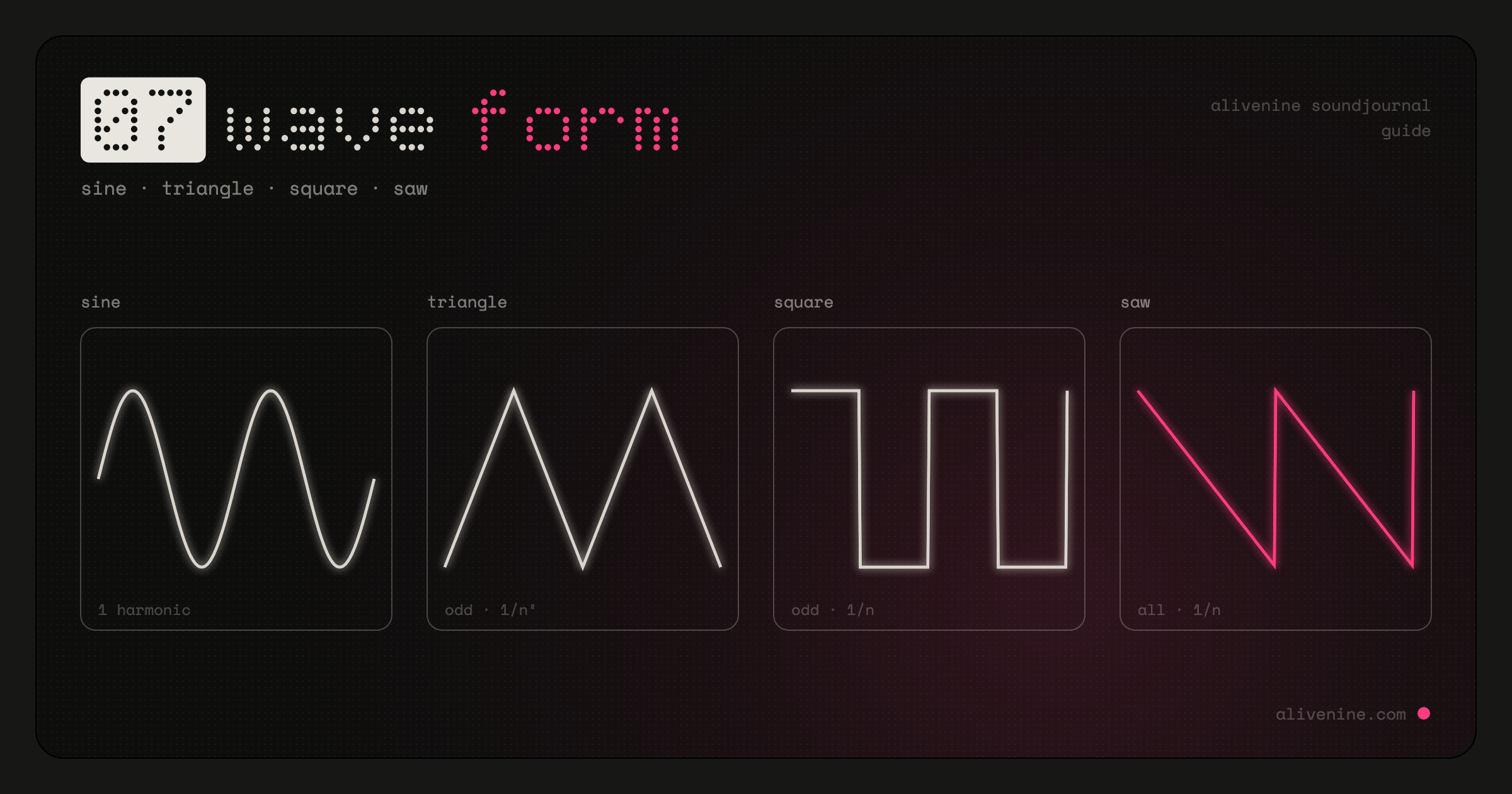
- the shape is made of harmonics. a sine has only the fundamental, a saw has all harmonics, a square and a triangle only the odd ones.
- more overtones means brighter and more present. fewer means rounder and softer.
- a filter can only remove overtones that are there. that's why most synth sounds start from a saw or a square.
- for sub bass, use a sine. for big chords and leads, start with a saw. for hollow, woody sounds, try a square or a narrow pulse.
what a waveform shows
Sound is air pressure moving back and forth. A speaker pushes the air, pulls it back, pushes again. A waveform draws that movement: time runs left to right, pressure up and down. In a DAW, the same picture shows the sample values of the recording.
Three things can be read off it.
- Frequency: how many times per second the shape repeats. 440 repeats per second is the A above middle C. Humans hear roughly from 20 Hz to 20 kHz, less at the top as we get older.
- Amplitude: how far the wave swings. Bigger swings are louder.
- Shape: what one cycle looks like. This is what makes a flute and a violin on the same note sound different, and it's called timbre.
A real recording rarely shows a clean repeating shape. A voice or a guitar changes its shape every few milliseconds. Synth oscillators are the exception: they repeat one cycle exactly, which is why their shapes are easy to see and to name.
harmonics: what the shape is made of
Every repeating shape can be built from sine waves. The lowest one, the fundamental, sets the pitch. Above it sit sines at two, three, four times the frequency and so on. These are the harmonics, or overtones. How loud each harmonic is decides the colour of the sound. The shape you see on a scope follows from that, together with the phase of each harmonic.
For a note at 110 Hz, the harmonics sit at 220, 330, 440, 550 Hz and up. The second harmonic is the octave, the third is an octave and a fifth, the fourth two octaves. That's why harmonics sound like part of the note and not like extra notes. The ear fuses them into one sound and only hears them as colour.
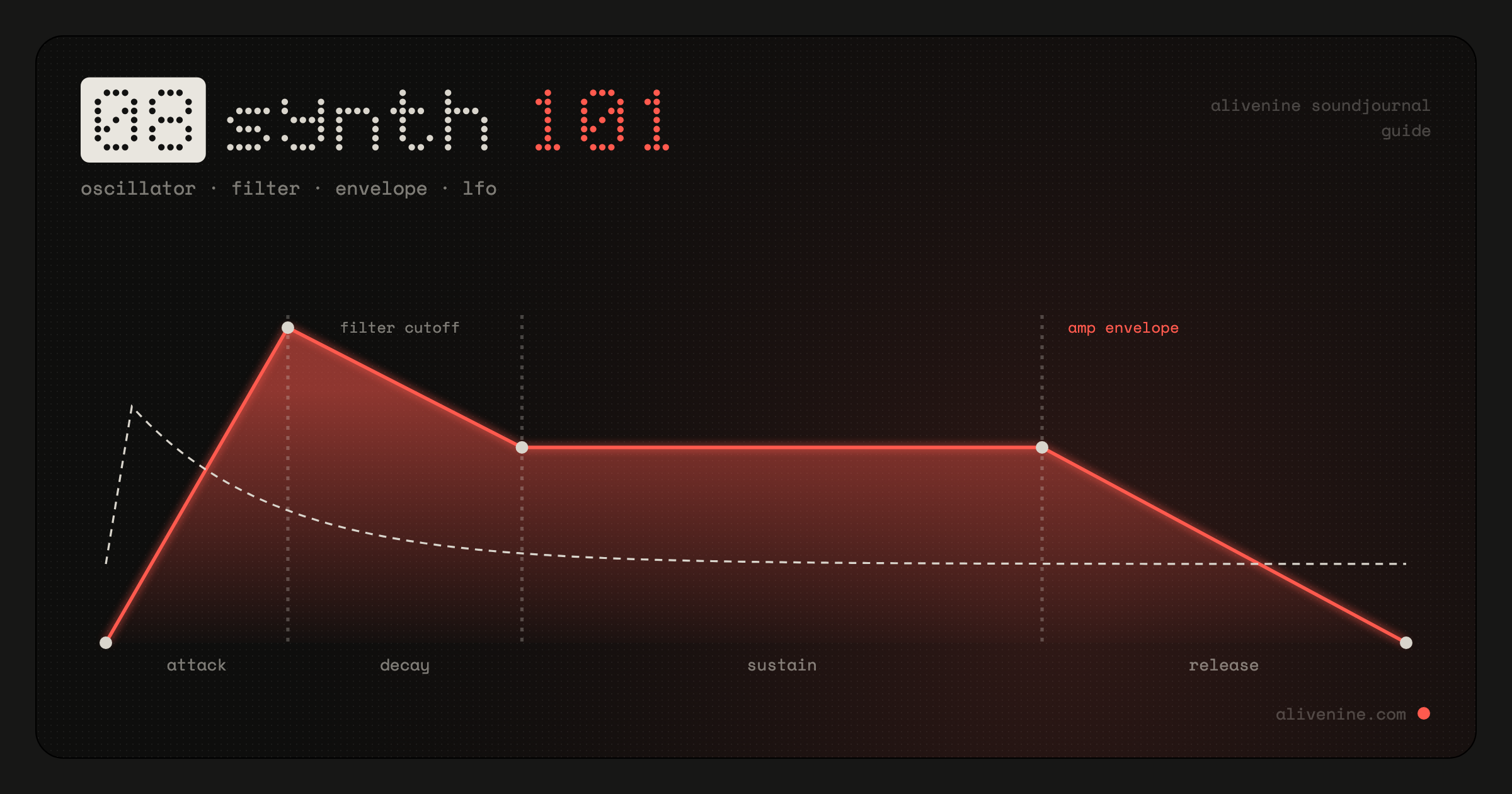
This idea is behind almost everything a synth does. A filter turns harmonics down. Distortion adds new ones. A spectrum analyzer shows them as a row of peaks. Once you think of a sound as a fundamental plus a stack of harmonics, most synth controls make sense.
the four classic waves
| Wave | Harmonics | Level of the harmonics | Sound |
|---|---|---|---|
| Sine | None, only the fundamental | None | Pure, round, almost invisible in a mix above the bass range |
| Triangle | Odd only: 3, 5, 7 … | Fall fast, 1 divided by n squared | Soft, a little hollow, like a sine with a bit of edge |
| Square | Odd only: 3, 5, 7 … | Fall slowly, 1 divided by n | Hollow, woody, reedy, typical for retro leads |
| Saw | All: 2, 3, 4, 5 … | Fall slowly, 1 divided by n | Bright, full, buzzy, the base of most pads and leads |
sine
The sine is the simplest wave and the only one with no harmonics. On its own, it sounds like a test tone. In music, it lives mostly in the sub bass and in kicks, where you want weight without anything that fights other instruments. A sine sub at 50 Hz is nearly silent on a phone, because the phone can't play the fundamental and there are no harmonics to carry it.
triangle
The triangle has only odd harmonics, and they drop away quickly. The third harmonic is about 19 dB below the fundamental, the fifth about 28 dB. The result is close to a sine, with a soft hollow edge. It works for gentle leads, flutes, and bass that needs to be heard a little more than a pure sine.
square
The square also has only odd harmonics, but they fall much more slowly. The third is about 10 dB below the fundamental. The missing even harmonics give it its hollow, clarinet like sound. Squares are the sound of many old game consoles and of a lot of synth bass in the eighties.
saw
The sawtooth has every harmonic, each one quieter than the last by the same rule as the square. It's the brightest and fullest of the four. Two or more slightly detuned saws give the wide pads and leads of trance and synthwave. A saw through a lowpass filter is the starting point of most synth sounds, because there is so much to shape.
pulse width
A square spends half of each cycle up and half down. A pulse wave changes that ratio. At 50 percent, it's a square. At 25 percent, it's up for a quarter of the cycle, and at 10 percent only briefly.
As the pulse gets narrower, harmonics that were missing come back, and the sound gets thinner and more nasal. At very narrow widths it starts to sound like a buzz. Moving the width slowly with an LFO, called pulse width modulation, gives a chorus like movement from a single oscillator. A lot of classic string and pad sounds come from exactly that.
noise and everything else
Noise has no repeating shape at all. White noise has equal energy at every frequency, pink noise has less energy as the frequency rises, which sounds more even to the ear. On a synth, noise adds air to pads, the hiss to hats and snares, and the rush of a riser.
Beyond the classic four, many synths offer wavetables: rows of single cycle shapes that you can move through while a note plays. Each position is a different waveform, so the colour changes over time. The principle is the same as above. Every shape is a stack of harmonics, and moving through the table changes the stack.
which wave for which sound
| Sound | Start with | Why |
|---|---|---|
| Sub bass | Sine | Weight without overtones that fight the kick or the bass above |
| 808 style bass | Sine with a pitch drop, a little saturation | Saturation adds harmonics so it's heard on small speakers |
| Acid, funk bass | Saw or square, lowpass with resonance | Many harmonics for the filter to sweep through |
| Pad, chords | Two detuned saws | Full and wide, movement from the detune |
| Retro lead | Square or pulse | Hollow and clear, cuts through without being harsh |
| Soft lead, flute | Triangle or sine | Few harmonics, sits gently above the mix |
| Hats, snares, risers | Noise | No pitch, all texture |
If a sound is too dull, the wave has too few harmonics, or the filter is too closed. If it's too harsh, the opposite. Switching from saw to square or triangle often fixes harshness faster than an EQ.
seeing waves while you work
An oscilloscope shows the shape of one cycle. A spectrum analyzer shows the harmonics as peaks. The two pictures show the same thing in two ways, and learning to read both makes sound design much faster.
alivebass, the bass synth I built, shows each oscillator in its own window with its waveform, and you click the window to change the shape: saw, square, an 808 shape, a super saw, a reese and a round wave. Next to it, the window shows the last four seconds of sound coloured by band and the spectrum, so you can see what a different wave does to the low end. You can try it in the browser with the real plugin code.
alivemeter, which is free, does the same for anything on your master: a waveform coloured red for the low end under 200 Hz, green for the mids and blue above 2 kHz, and a spectrum that shows the note and cents under the cursor. Put it after a synth and switch waves. The change shows up in both the waveform and the spectrum.
listening tips
- Play the same note with each wave at the same loudness. Saw and square sound louder at the same peak level, so match by ear.
- Listen on a phone speaker. The sine nearly disappears, the saw stays.
- Sweep a lowpass filter slowly over a saw, with a little resonance. You hear the harmonics drop out one by one, from the top.
- Compare a square and a narrow pulse on a bass note. The pulse sounds thinner but cuts through more.
faq
What is a waveform in music?
It's the shape of a sound over time. How often it repeats sets the pitch and how far it swings sets the level. The shape itself is the colour of the sound, called timbre.
What is the difference between a sine, square and saw wave?
A sine has no harmonics and sounds pure. A square has only odd harmonics and sounds hollow. A saw has all harmonics and sounds bright and full.
Which waveform is best for bass?
A sine for sub bass, because it gives weight without overtones that clash. For a bass that should be heard on small speakers, use a saw or square through a lowpass filter, or add saturation to a sine.
Why do saw waves sound bright?
A saw contains every harmonic of the note, and they fade out slowly toward the top. All that energy above the fundamental is what the ear hears as brightness.
What does pulse width do?
It changes how long the wave stays up in each cycle. At 50 percent it's a square. Narrower pulses add back harmonics and sound thinner and more nasal. Moving the width over time gives a chorus like movement.
What is the difference between a waveform and a spectrum?
A waveform shows the sound over time. A spectrum shows how much energy sits at each frequency. Both describe the same sound, one by its shape and one by its harmonics.
For a step further into building sounds, read how to use a synthesizer. For what happens when perfect waves sound too clean, there's how to make soft synths sound analog.