· by max
how to make a kick drum punchy
A punchy kick hits hard and fast at the start, and the rest gets out of the way in time. Most kicks that feel weak have plenty of level. The energy just arrives too slowly or rings too long. Below, the kick is split into its parts, with values for each and the tools that add or remove punch. alivedrum, the drum synth I built, comes in near the end.
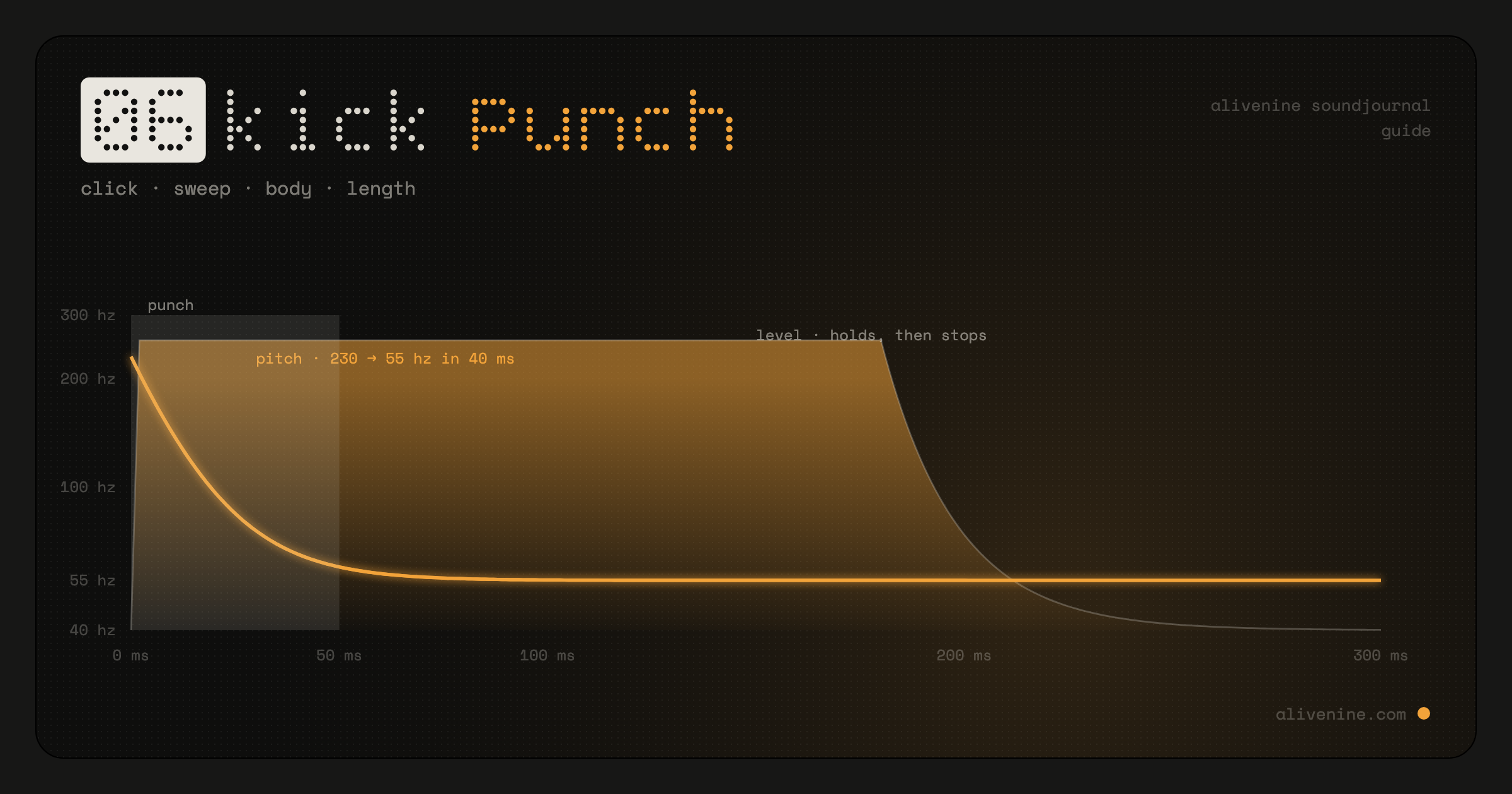
- a kick has four parts: the click, the pitch sweep, the body and the tail. punch lives in the first 50 ms.
- a pitch sweep that falls from about 150 to 250 hz down to the body in 20 to 60 ms is most of what you hear as punch.
- a short tail makes a kick sound bigger in a dense mix than a long one.
- a transient shaper and gentle clipping add punch. heavy compression on the kick usually removes it.
- keep the kick mostly out of 100 to 500 hz. that range makes it boxy and fights the bass and snare.
what a kick is made of
An electronic kick is easiest to understand as four pieces in a row. They overlap, but each one has its own job.
| Part | Time | Where it sits | What it does |
|---|---|---|---|
| Click | First 2 to 10 ms | About 2 to 5 kHz | Makes the kick audible on small speakers, defines where the beat is |
| Pitch sweep | First 20 to 60 ms | Falls from 150 to 250 Hz down to the body | The punch you feel in the chest |
| Body | After the sweep | About 45 to 80 Hz | The weight and the note of the kick |
| Tail | The rest | Same as the body, fading | Length, and space taken away from the bass |
When a kick feels weak, one of these four is off. The click is missing, so it disappears on a laptop. The sweep is too slow or too shallow, so there's no hit. The body is in the wrong place, so it fights the bass. Or the tail is too long, so the next sound has nowhere to go.
the pitch sweep
The sweep is most of the punch. A sine wave starts high and drops quickly to the body pitch. As long as it's fast, the ear hears that drop as one hit.
values to start with
- Start pitch: about 150 to 250 Hz. Higher sounds clickier and more aggressive, lower rounder.
- Sweep time: 20 to 60 ms. Under 20 ms the sweep turns into a click, over 80 ms it starts to sound like a laser.
- Curve: exponential, fast at the start and slow at the end. A straight line sounds artificial.
- End pitch: the note of your body. If you want it in key, see how to tune your kick.
In a synth, that means a pitch envelope with zero attack, a decay of 20 to 60 ms, an amount of about one and a half to two and a half octaves, and the oscillator's pitch set to the body note. Turn the amount down until the kick sounds soft, then back up until it hits.
the click
The click is a very short burst at the start, often noise or a tiny tick, sometimes the sound of a beater on a skin. It carries almost no energy and changes the kick completely. Without it, a deep kick disappears on a phone, because phones play very little under about 200 Hz.
Keep it short, a few milliseconds, and keep it narrow. A click around 3 to 5 kHz cuts through. A wide click that reaches up to 10 kHz sounds thin and plastic. Layering a separate click sample works too, as long as you line up its start with the start of the sweep, down to the sample.
body and length
The body gives the kick its weight. The tail decides how much room is left for everything else. The most common mistake is a tail that's too long.
A long tail sounds great solo. In a track, it overlaps the bass and the next kick, and the low end turns into one long hum. At 124 BPM, a beat lasts 484 ms. A kick that rings for 400 ms leaves almost no space for a bass on the offbeat. Try 150 to 300 ms for house and techno, and let only hip hop and trap 808s ring longer, because there the kick is the bass.
The shape of the end matters too. A kick that fades out slowly feels soft. A kick that holds its level and then stops short feels tight and punchy. Many produced kicks in loops do exactly that: they stay full and then close hard.
processing that adds punch
transient shaper
A transient shaper raises or lowers the attack and the sustain of a sound without a threshold. More attack makes the hit sharper, less sustain shortens the tail. On a kick, a few dB more attack and a few dB less sustain is often all it takes. Put it after reverb or room on the kick. Less sustain then shortens the room together with the kick, so the kick stays dry and compact.
saturation and clipping
Saturation adds overtones to the body, so the kick is heard higher up the spectrum without an EQ boost. Clipping cuts the top of the waveform. Soft clipping a kick by 1 to 3 dB lets you raise its level without raising its peak, and adds a little bite. Use oversampling if the clipper offers it, so the overtones don't fold back as harsh noise.
compression, carefully
A compressor with a fast attack on the kick catches the very part you want, the first milliseconds. That's why heavy compression often makes a kick duller. If you compress, use a slower attack, around 10 to 30 ms, so the hit passes first. A bus compressor on the whole drum group with a medium attack and gentle ratio helps the kit sound like one instrument.
eq: where to cut
- Under 30 Hz: a gentle high pass removes rumble you can't hear but that eats headroom.
- 100 to 500 Hz: this is where a kick gets boxy and cardboard like. A cut of a few dB around 200 to 400 Hz often helps more than any boost.
- 2 to 5 kHz: a small boost brings out the click, if the kick has one.
- Above 8 to 10 kHz: usually nothing useful in a kick. Rolling it off makes the whole beat sound darker and older.
Cut first, boost last. A kick that needs a big boost somewhere usually needs a different source.
punch in the mix
A kick that punches solo can still disappear in the track. Two things usually cause it.
Other sounds sit on top of its attack. A bass, a pad or a reverb that's loud in the first 50 ms after each kick steals the hit. A short duck on those tracks, triggered by the kick, gives the punch back without making the kick louder. The bass is the most important one, see how to make a bassline.
The limiter on the master flattens it. A limiter pulling 4 to 6 dB on every kick flattens the hit. If the kick loses its hit at the end of the chain, back the limiter off and check the result with a meter. Our guide to loudness meters explains which numbers to read.
building it in alivedrum
alivedrum is a drum synth with no samples. The kick is built from two layers, which map directly onto this guide. The body layer is the tuned sine with its sweep: tune, decay and punch, where punch sets the pitch drop at the start. The click layer is its own sound, with a choice between noise, tick and beater, plus tone, decay and snap.
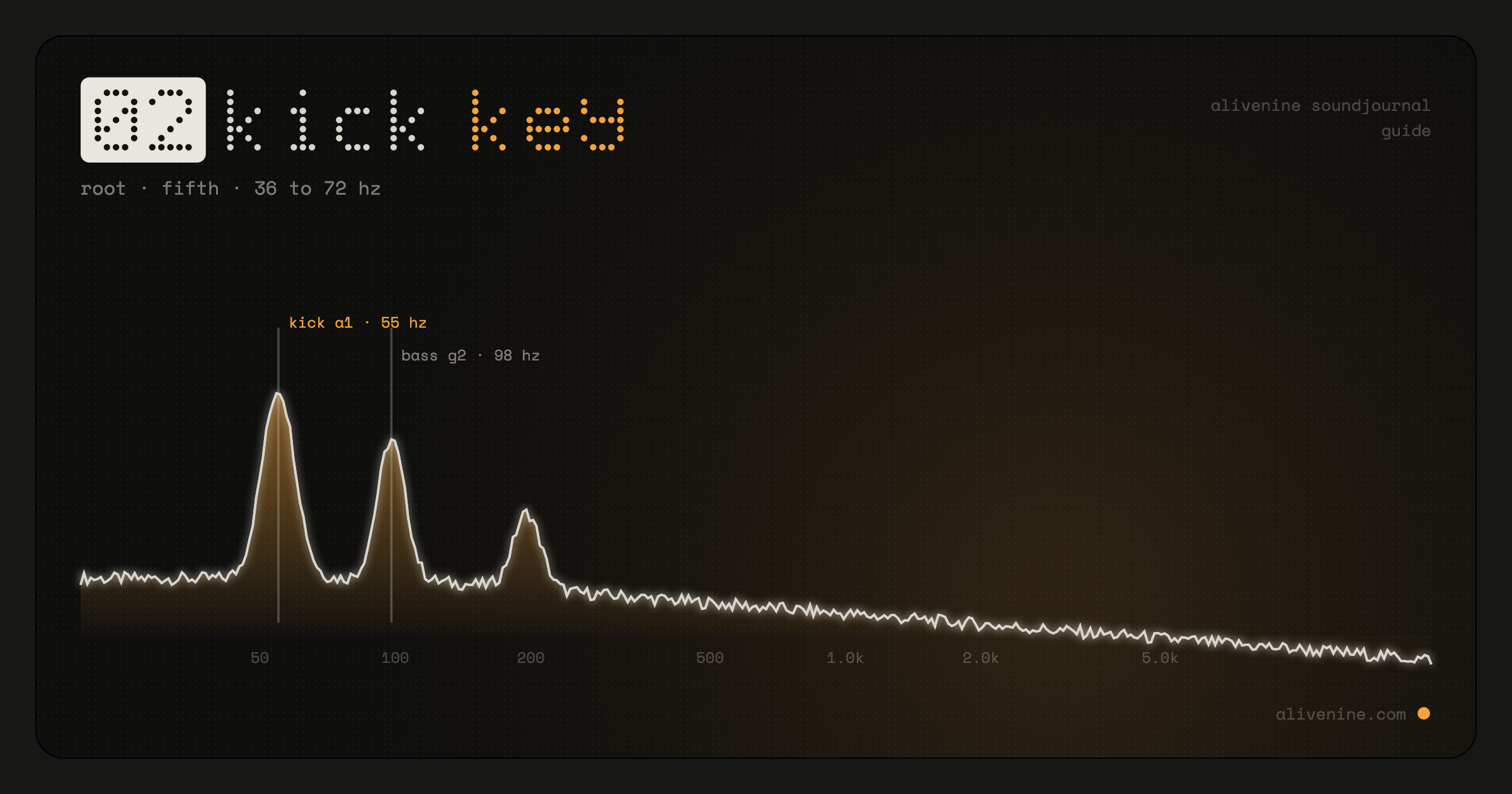
shape goes from a decaying kick to a block that holds and then stops hard, the shape of many produced loops. range switches between a sub kick from 49 to 58 Hz and a punch kick from 58 to 70 Hz. By design, the kick puts almost nothing between 100 and 500 Hz, and its click sits narrow around 4 kHz with everything above 7 kHz closed.
Each track has a ready chain with saturation, a slap echo, a room with a gate, and a transient shaper with attack and sustain after the effects, so the kick stays dry and tight even with room. The master adds drive and a soft clipper, both with four times oversampling, and a limiter with 1.5 ms lookahead. vary makes every hit slightly different, so a four to the floor doesn't sound like a loop. You can play alivedrum in the browser with the real plugin code.
If you work with samples, everything above still applies. Pick a kick with a clear click and a short tail, and shape it with the same moves.
listening tips
- Judge punch at a moderate level. Very loud, every kick sounds punchy.
- Listen on a laptop or a phone. If you only hear a thump and no click, the kick will vanish there.
- Loop kick and bass alone. If the kick loses its hit when the bass comes in, the bass needs to duck.
- Bypass your master limiter for a moment. If the kick suddenly jumps out, the limiter is eating it.
- Compare with a reference at the same loudness and listen only to the first beat of each bar.
faq
How do I make my kick punchier?
Shorten the tail, speed up the pitch sweep to 20 to 60 ms, add a short click around 3 to 5 kHz, and use a transient shaper for a little more attack. Then make sure the bass and other sounds duck out of the first 50 ms of each kick.
What frequency gives a kick its punch?
The punch comes from the pitch sweep, which falls from about 150 to 250 Hz down to the body at 45 to 80 Hz in the first tens of milliseconds. The click around 3 to 5 kHz makes that punch audible on small speakers.
Should I compress my kick drum?
Lightly, if at all. A fast attack removes the very transient that makes a kick punchy. If you compress, use an attack around 10 to 30 ms, or use a transient shaper instead.
Why does my kick sound boxy?
Usually because of too much energy between 200 and 400 Hz. Cut a few dB there, or choose a kick whose body sits lower and whose click sits higher.
How long should a kick drum be?
For house and techno, 150 to 300 ms is a good range. Hip hop and trap 808s ring longer because they double as the bass. The right length leaves space before the next bass note.
Does clipping a kick make it louder?
It lets you raise the level without raising the peak. Soft clipping 1 to 3 dB off a kick adds bite and loudness. More than that starts to sound distorted.
Get the first 50 ms right and leave room after them. Play alivedrum in the browser and turn punch and shape on the kick. Then tune it, with how to tune your kick to the key of your track.