· by max
how to make soft synths sound analog
A soft synth can sound good and still feel like a computer. The difference to hardware is rarely the oscillator. It's the small things that never stand still: pitch that wanders by a few cents, voices that don't quite agree, a filter that rounds off the top, and a tape machine that adds its own wobble. Below are values for each of them. alivedrift, which I made for exactly this, is free.
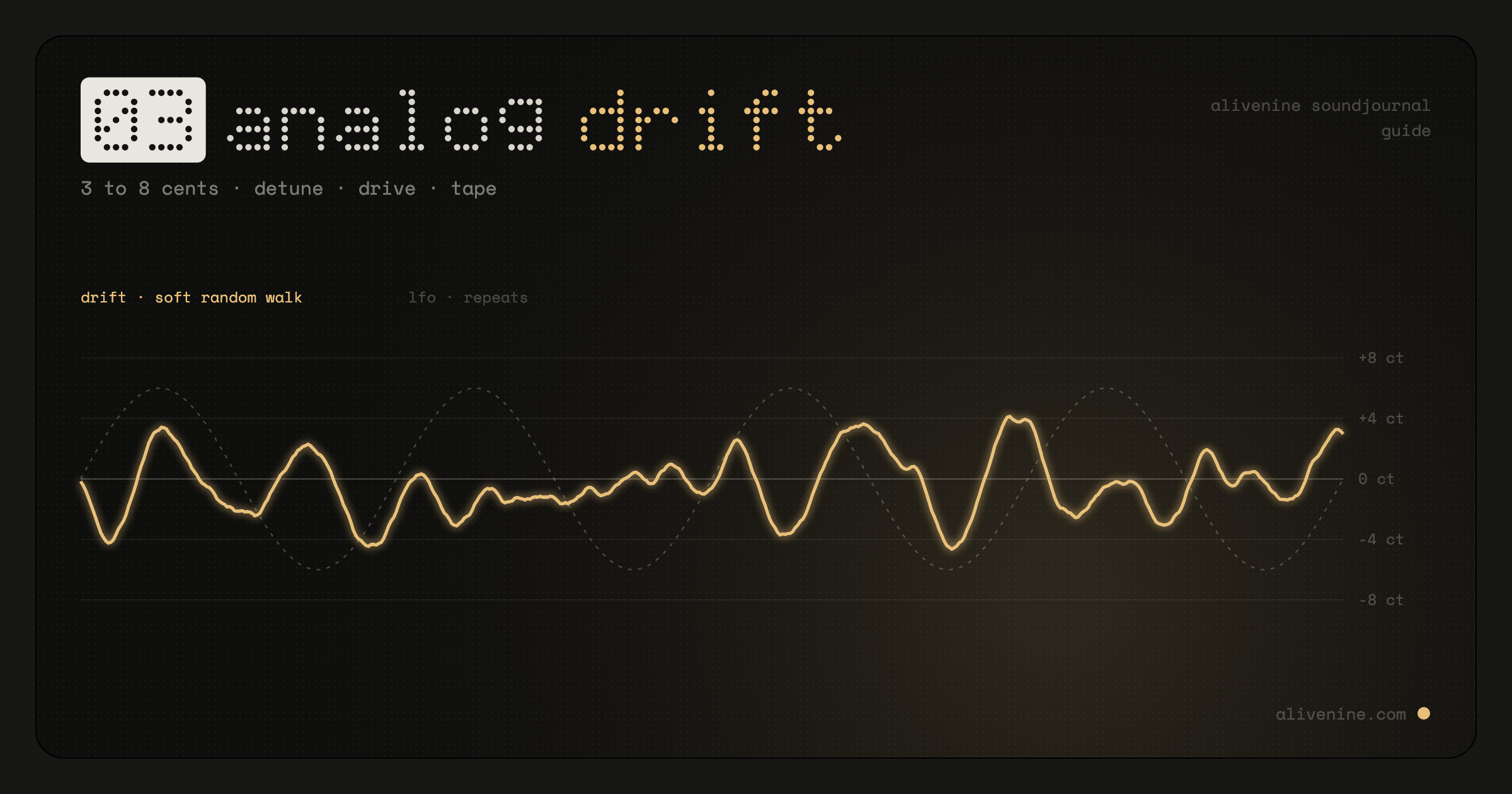
- analog oscillators drift. a random movement of 3 to 8 cents feels alive without sounding out of tune.
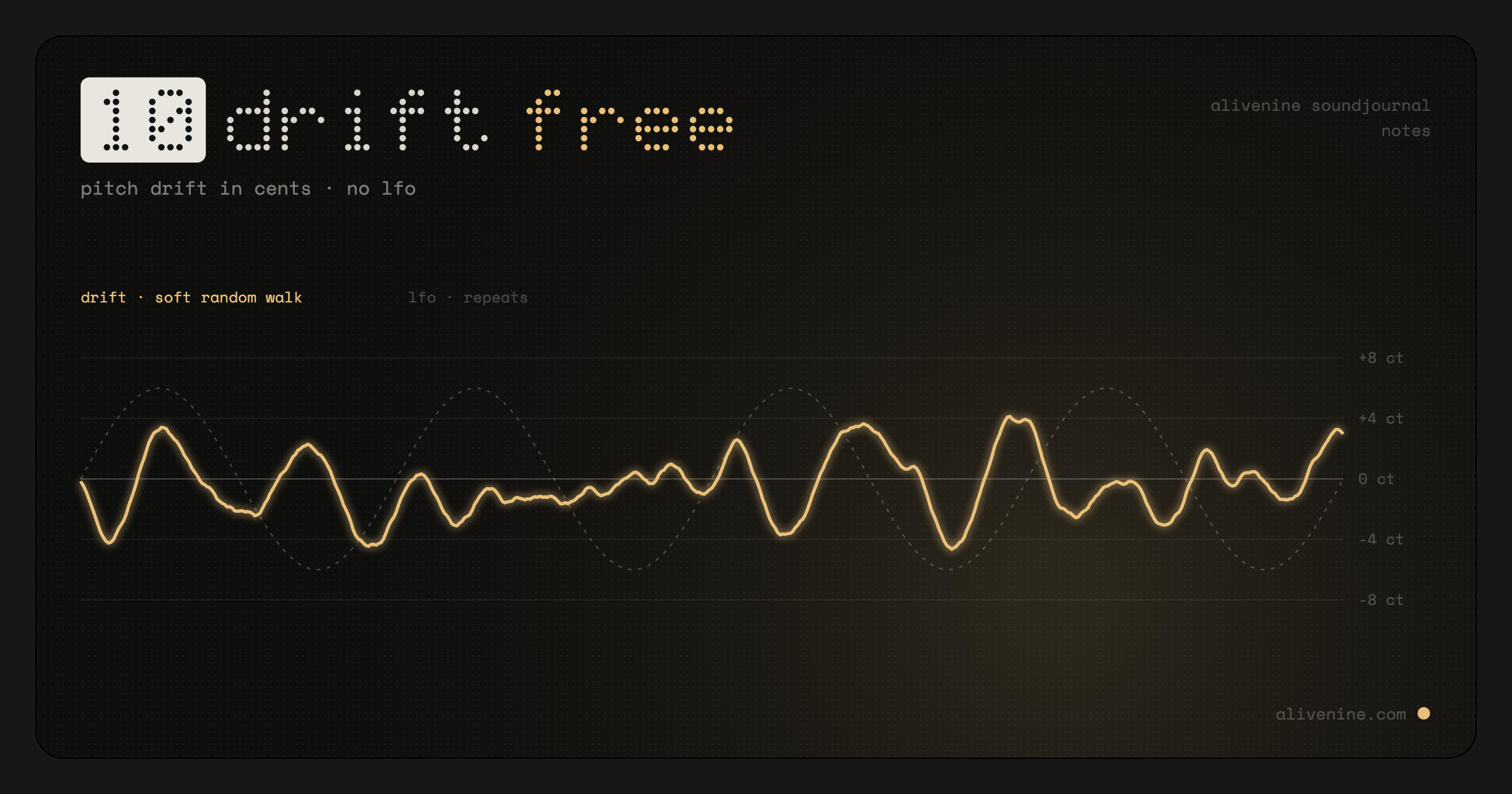
- an lfo is not drift. it repeats, and the ear notices the pattern within a few cycles.
- detune between voices of 5 to 15 cents gives width and movement. beyond 20 cents it becomes an effect.
- light drive and a softer top end do more than any vintage preset. part of a hardware synth's warmth is what's missing above 10 khz.
- tape adds wow, flutter and saturation in one step. small amounts are enough.
what "analog" really means
What people call analog is mostly a set of small faults. The oscillators in an old synth change pitch with temperature and age. Two voices on the same note never land on exactly the same frequency. The filter and the amplifier distort a little when you push them. The signal often ended up on tape, which bent the pitch again and softened the highs.
A soft synth leaves all that out by default. Every note sits on the exact frequency, every voice agrees, and the top end goes up to 20 kHz. That is precise, and it's also why a chord can feel flat even when the sound itself is good. The job is to put a little of the fault back, and to stop before it becomes the sound.
Pitch is measured in cents. 100 cents are one semitone. Most people stop hearing a static difference somewhere around 5 cents, but they do feel movement well below that.
pitch drift
Drift is the slow, unpredictable change of pitch over time. On hardware it comes from heat and from the tiny instabilities of the circuit. It never repeats, and it always wanders back toward the right pitch.
why an lfo doesn't sound like drift
The obvious way to fake it is a slow LFO on pitch. The problem is that an LFO is a cycle. After two or three passes, the ear hears the pattern, and the sound starts to feel like a vibrato effect instead of an instrument. A random LFO is closer, but if it steps from value to value, it sounds like a sample and hold.
What works is a soft random walk: a value that moves smoothly in random directions and is pulled back toward the centre, so it never drifts too far. That is how alivedrift works inside. There is no LFO, only smooth randomness measured in cents.
values to start with
| Depth | What you hear | Where it fits |
|---|---|---|
| 2 to 4 cents | Nothing you could point at. The sound feels less fixed. | Pads, chords, anything sustained |
| 5 to 8 cents | A quiet life in the sound, like a warm oscillator | Leads, keys, basslines above the sub |
| 10 to 20 cents | A clear wobble, like old tape | Lofi, ambient, single elements |
| 30 cents and more | Seasick, the effect is the point | Transitions, sound design |
Speed matters as much as depth. A slow drift, one change every few seconds, reads as warmth. A fast one reads as vibrato. Keep it slow first, then add depth until you notice it, and back off a little.
alivedrift
alivedrift puts this on any track. You pick a starting point, subtle, analog, tape, breathe, seasick or slip, and then turn the knobs freely. drift sets the depth in cents, rate the pace, flutter adds a fast fine tremble like a tape machine, and width gives left and right their own movement. calm adds rests: the pitch holds still and only now and then slips away, which is closer to how a tired oscillator behaves than constant motion. A filter drift section can let a lowpass wander too.
The window shows the pitch of the last 6 seconds in cents, so you see what you hear. The latency is a fixed 20 ms, which your DAW compensates. alivedrift is free in alivehub as AU, VST3 and app, and you can try it in the browser. We wrote a short note on why we built it.
If you already have Pitch Drift by Baby Audio, it's free as well and does the slow wobble nicely. Use whichever you like. The depths above apply to both.
detune between voices
Drift moves one voice over time. Detune is the difference between two voices at the same time. When two oscillators sit a few cents apart, they phase against each other, and the sound gets wider and starts to move by itself.
- 5 to 10 cents between two oscillators: full and warm, the classic analog thickness.
- 10 to 20 cents: wide and moving, good for pads and stabs.
- Above 20 cents: a chorus or supersaw effect. Great when wanted, but it washes out chords.
Two details make it feel less digital. First, give each voice of a chord a slightly different detune, so the beating doesn't line up. Many synths call that analog, slop or spread. Second, start the oscillators at a random phase on every note. A free running oscillator sounds different on every hit, a reset one sounds identical.
Keep the sub out of it. Under about 120 Hz, detune and width make the low end weaker on a mono system. If the bass carries the root, keep its lowest part mono and in tune. Our note on a bass that leaves room explains why we split at 120 Hz.
drive and saturation
Analog circuits distort softly when the level goes up. The louder parts of the wave are rounded, which adds overtones and makes peaks smaller. The sound gets denser without getting louder.
Start with a saturation plugin after the synth and set it so the output level barely changes. Raise the drive until you hear the sound get thicker, then back off by a third. In numbers, that's often a gain reduction of 1 to 3 dB on the peaks. Even overtones, the second and the fourth, sound warm. Odd ones, the third and the fifth, sound harder and more aggressive.
The order matters. Drive before the filter gives a rough sound that the filter smooths. Drive after the filter adds back some of the edge the filter took away. Hardware usually does a bit of both.
a softer top end
An old synth rarely puts much energy above 10 kHz. Its filter is often partly closed, and the parts after it roll off the highest frequencies. A soft synth with an open filter fills everything up to 20 kHz, and that air is one of the first things the ear reads as digital.
Try a gentle lowpass or high shelf between 8 and 12 kHz on the synth bus, around 6 to 12 dB per octave. A steep cut sounds wrong. A gentle slope sounds like the synth itself got darker. Digital oscillators can also alias, which shows up as harsh tones that don't follow the notes. If a synth has an oversampling or quality switch, turn it on before you start shaping the tone.
The same idea holds for drums. Hats and snares that stop softly around 8 to 10 kHz, instead of hissing up to 16 kHz, make the whole beat sound older.
tape: wow, flutter, noise
A lot of what sounds like an analog synth is really an analog synth played back from tape. Tape changes the sound in four ways at once.
- Wow is a slow change of speed, so the pitch rises and falls over a second or so.
- Flutter is a fast tremble on top, many times a second.
- Saturation rounds off loud highs first, so the tape gets warmer as you drive it.
- Noise and small dropouts add a floor that the music sits on.
On real machines, wow and flutter are measured as a fraction of a percent of the tape speed. For music, small amounts go a long way. A wow depth you can't quite hear on the dry synth often becomes obvious once there's an echo, because each repeat bends further.
alivetape
alivetape is a tape echo built around a finite loop of tape. Its tape age control adds wow, flutter, drift, high loss, noise and dropouts together, from fresh tape at 0 to seasick above 80 percent. The input drive goes from -12 to +18 dB, and pushing it gives saturation and tape compression. Slower tape sounds darker and thicker, just like on a real machine.
The loop has a splice and worn spots, and they come back at the same place on every pass, through each of the three heads in turn. You start to recognise a fault on the next round, the way you would on a real loop. With the echo mixed low and long, alivetape works as a tape colour on a synth bus. You can play it in the browser, and grab the tape with the mouse to rewind it.
a chain to start from
For a pad or a chord synth that feels too clean, try this order on its track, and set each step lightly.
| Step | What | Starting point |
|---|---|---|
| 1 | In the synth: detune and random phase | 5 to 10 cents between oscillators, slight spread per voice |
| 2 | Pitch drift | 3 to 6 cents, slow |
| 3 | Saturation | 1 to 3 dB on the peaks, output level matched |
| 4 | Top end | Gentle lowpass at 9 to 11 kHz |
| 5 | Tape or tape echo | Low wow and flutter, echo low in the mix |
If the synth already drifts by itself, skip step 2. alivesynth is built that way: its oscillators, drift and pitch are tuned to each other, so every chord arrives warm and full before you add anything.
listening tips
- Bypass each step after 30 seconds. The ear adapts to drift and saturation quickly. The change shows best when you switch it off.
- Listen in context. A drift that sounds too much on a solo pad often disappears in the mix.
- Check in mono. Detune and width can thin a sound out when the left and right sides cancel.
- Hold a long chord. Pitch drift is hardest to judge on short notes and easiest on a sustained one.
- Compare at the same loudness. Saturation makes things louder, and louder always sounds warmer at first.
faq
How do I make a soft synth sound analog?
Add a little of what hardware does by accident: a slow random pitch drift of a few cents, some detune between voices, light saturation, a softer top end above 10 kHz and, if it fits, a touch of tape. Small amounts of each work better than a lot of one.
How many cents of drift sound analog?
3 to 8 cents of slow, random movement feels like a warm oscillator. Above about 10 cents it becomes an audible wobble, which is fine for lofi and ambient but too much for most chords.
Is there a free pitch drift plugin?
Yes. alivedrift is free in alivehub for Mac as AU, VST3 and app. Pitch Drift by Baby Audio is also free.
What is the difference between drift and vibrato?
Vibrato is a regular, repeating change of pitch, usually several times a second. Drift is slow and irregular and never repeats.
Does saturation make a synth sound analog?
It helps. Light saturation adds overtones and rounds peaks the way analog circuits do. On its own it makes a synth denser, but it won't add the movement that drift and detune bring.
Why do digital synths sound harsh?
Often because of an open top end up to 20 kHz, and sometimes because of aliasing from the oscillators. A gentle lowpass around 10 kHz and the synth's oversampling or quality setting usually fix most of it.
Start with alivedrift, it costs nothing, and listen to the chord you already have. For the low end under it, read how to make a bassline.