· by max
what is a step sequencer, and how to use one
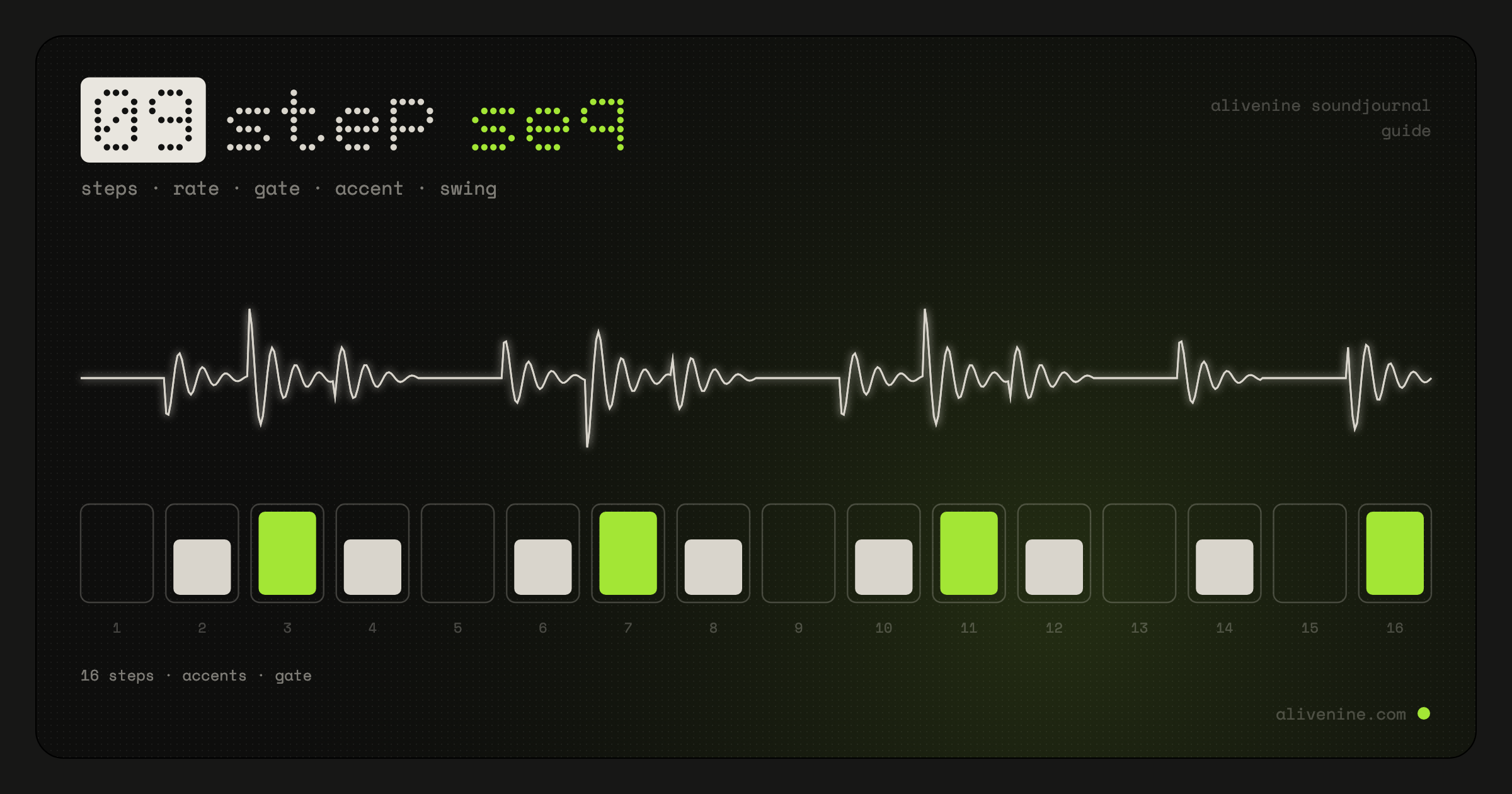
A step sequencer splits a bar into equal slots and lets you switch each slot on or off. It's one of the oldest ways to program electronic music and still one of the fastest, because you don't play the pattern, you build it. Drum machines and acid basslines come from this grid.
- a step sequencer divides a bar into steps, usually 16 sixteenth notes, and plays them in a loop.
- each step can hold a note, a level, a length and sometimes a slide or a repeat.
- accents and gate length make more groove than extra notes.
- swing delays every second step. 52 to 56 percent loosens a groove, 57 to 62 percent swings clearly.
- sequences of different lengths drift against each other. 12 against 16 steps line up again after 3 bars, 7 against 16 after 7 bars.
what a step sequencer is
A step sequencer plays a row of steps one after the other, at a fixed rate, in a loop. Each step is either on or off. When the playhead reaches an active step, it triggers a note. In 4/4 with 16 steps, each step is one sixteenth note, and four steps make one beat.
The idea comes from the analog sequencers of the sixties and seventies, rows of knobs that sent a voltage to a synth, one knob per step. Drum machines brought the same grid to beats: a row of buttons per sound, lit when the step plays. It's still how most people write drums, because the grid shows the rhythm at a glance.
step sequencer or piano roll
A piano roll is a free canvas. Notes can start anywhere, be any length and overlap. A step sequencer is a grid with fixed slots.
| Step sequencer | Piano roll | |
|---|---|---|
| Timing | Locked to the grid, swing applied as a whole | Free, every note anywhere |
| Writing | Switch steps on and off, fast and repetitive | Draw or record, better for melodies and chords |
| Best for | Drums, basslines, arps, loops that evolve | Chords, long melodies, played parts |
| Feel | Machine, tight, hypnotic | As human as the player |
A lot of tracks use both: the step sequencer for drums and bass, the piano roll for chords and the top line.
the controls
steps and length
The number of steps sets the pattern length. 16 steps of sixteenths is one bar. 32 steps is two bars, or one bar of 32nd notes. Shorter lengths like 12 or 7 create patterns that shift against the bar, more on that below.
rate
The rate sets how long each step is. 1/16 is the standard. 1/8 halves the speed. 1/16t, sixteenth triplets, fits six steps into a beat and gives a rolling, swung feel. 1/32 doubles the speed for fast hats and rolls.
gate
Gate is the length of the note inside its step, as a percentage. At 25 percent the note is short and staccato, at 100 percent it fills the step, and above 100 percent it overlaps the next one. On a mono synth with glide, an overlapping note slides into the next instead of retriggering. That's the classic acid slide.
velocity and accent
Velocity is how hard each step plays. Accent is a simpler version: a step is either normal or accented. Many sequencers also have a ghost level, very quiet. A pattern of sixteenths with every fourth step accented already grooves. The same pattern at one level sounds like a machine gun.
ratchets and probability
A ratchet repeats a step two, three or four times within its slot, for rolls and stutters. Probability gives each step a chance to play, like 70 percent, so the pattern changes slightly on every pass. Both add life to a loop without writing more bars.
slide, tie and transpose
A tie holds a note over the next step instead of playing a new one. A slide glides the pitch to the next note. Transpose moves the whole pattern in pitch, often in steps of the key, so one rhythm can follow a chord progression.
swing
Swing delays every second step. In a step sequencer it's usually set as a percentage. At 50 percent, every step is evenly spaced, straight. At 66 percent, the off step sits at the triplet position, a full shuffle.
| Swing | Feel | Where it fits |
|---|---|---|
| 50 % | Straight, mechanical | Techno, synthwave, eighties pop |
| 52 to 56 % | A little looser, still sounds straight | House, most electronic music |
| 57 to 62 % | Clearly swung, bouncy | Garage, hip hop, deep house |
| 66 % and more | Full shuffle, triplet feel | Shuffle, swing, some breakbeats |
Swing affects the off steps only, so hats feel it most. If a beat sounds too stiff but too much swing makes it wobble, try swing only on the hats and keep kick and bass straight.
odd lengths and polymeter
Set the hats to 16 steps and a percussion part to 12 steps. Both play at the same rate, but the percussion loop restarts every three beats while the bar is four beats long. The two parts drift against each other and line up again only after 48 steps, three bars.
With 16 against 7 steps, they meet again only after 112 steps, seven bars. A short pattern can feel like it never repeats. One part on 16 steps and one on an odd length is one of the simplest ways to keep a loop interesting for minutes.
patterns to try
Sixteen steps each, x is a note, - is a rest. Play them at 120 to 128 BPM.
| Part | Pattern | Notes |
|---|---|---|
| Four on the floor kick | x---x---x---x--- | The base of house and techno |
| Offbeat hat | --x---x---x---x- | Between the kicks |
| Sixteenth hats | xxxxxxxxxxxxxxxx | Accent every fourth, swing 55 % |
| Clap or snare | ----x-------x--- | Beats two and four |
| Acid bass | x-xx-x-xx-x-xx-x | Gate 50 %, a few slides, accents on the first of each pair |
| 12 step perc | x--x-x--x-x- | Set the length to 12 and let it drift |
step sequencing in ableton and logic
Ableton Live: a Drum Rack gives each sound its own row in the MIDI editor, which works like a step grid. Set the grid to 1/16, click steps in, and use velocity for accents. The Groove Pool adds swing and timing feel to a clip without moving the notes by hand.
Logic Pro: Logic has its own step sequencer with rows, per step velocity, gate, repeat and probability, and lengths per row, so odd lengths and polymeter are built in.
If you already use a hardware drum machine or groovebox, its sequencer works the same way. The controls above apply to any of them.
step sequencing in the alivetools
Several of the alivetools I built have a sequencer inside, each one made for its part.
alivebass fills a sixteen step sequencer as you play. You click steps on and off, drag them for accent, and move them up or down in the key. Steps can hold the note before them for long notes, and a held step on a different pitch slides without a new attack, the acid slide from above. One click writes a new line that stays in the style of the chosen world, and the sequencer can run over two bars.
alivearp takes the arpeggiator further. One key builds a chord from your key, root, third, fifth, seventh, ninth, and the pattern only plays those tones. So random notes, octave jumps and ratchets never land wrong. Each pattern has 1 to 999 variations, shifted, reversed or mirrored. The rhythm stays, only which chord tone comes when changes. Press harder to latch, and the app also shows up on your Mac as a MIDI source, so it can play any synth.
You can try both in the browser with the real plugin code: alivebass and alivearp.
listening tips
- Loop one bar for a long time. A pattern that's still fun after two minutes is a good one.
- Change only accents and gate before adding notes. Groove usually hides there.
- Try the same pattern at 50 and at 56 percent swing, on a big speaker if you can.
- Mute one part at a time. If nothing feels missing, the part wasn't needed.
- Listen to where odd lengths meet the bar again.
faq
What is a step sequencer?
A tool that divides a bar into equal steps, usually 16 sixteenth notes, and plays them in a loop. You switch each step on or off and can set its pitch, level and length.
What is the difference between a step sequencer and a piano roll?
A step sequencer locks notes to a grid of fixed slots and is fast for drums, basslines and arps. A piano roll lets notes start anywhere and be any length, which suits chords and played melodies.
What does gate mean on a sequencer?
Gate is how long the note plays inside its step, as a percentage. Short gates sound staccato, long gates legato, and a gate over 100 percent overlaps the next step, which on a mono synth with glide gives a slide.
How much swing should I use?
52 to 56 percent loosens most electronic music without sounding swung. 57 to 62 percent gives a clear bounce for garage and hip hop. 66 percent is a full shuffle.
What is polymeter in a sequencer?
Two parts with different step counts, like 16 and 12, playing at the same rate. They drift against each other and only line up again after the smallest number both fit into, 48 steps in that example.
Does Logic Pro have a step sequencer?
Yes. Logic Pro has a step sequencer with rows, per step velocity, gate, repeat and probability, and its own length per row.
Once the pattern runs, the sound matters. How to use a synthesizer covers the basics, and how to make a bassline shows how to write the part under it.