· by max
how to make kick and bass work together
Kick and bass share the same two octaves, and in most tracks they also share the same moments. That's why the low end goes wrong first. The fix is rarely one plugin. It's a handful of small decisions, below in a useful order, with the numbers behind each one. alivebass and alivedrum, the bass and drum synths I built, come in near the end.
- in the finished songs we measured, 40 to 70 percent of the energy sits below 120 hz, and only 3 to 11 percent between 250 and 500 hz. kick and bass share the first range and should leave the second one mostly empty.
- decide who owns the attack and who owns the sustained note. a short kick and a bass that comes in after it rarely need heavy processing.
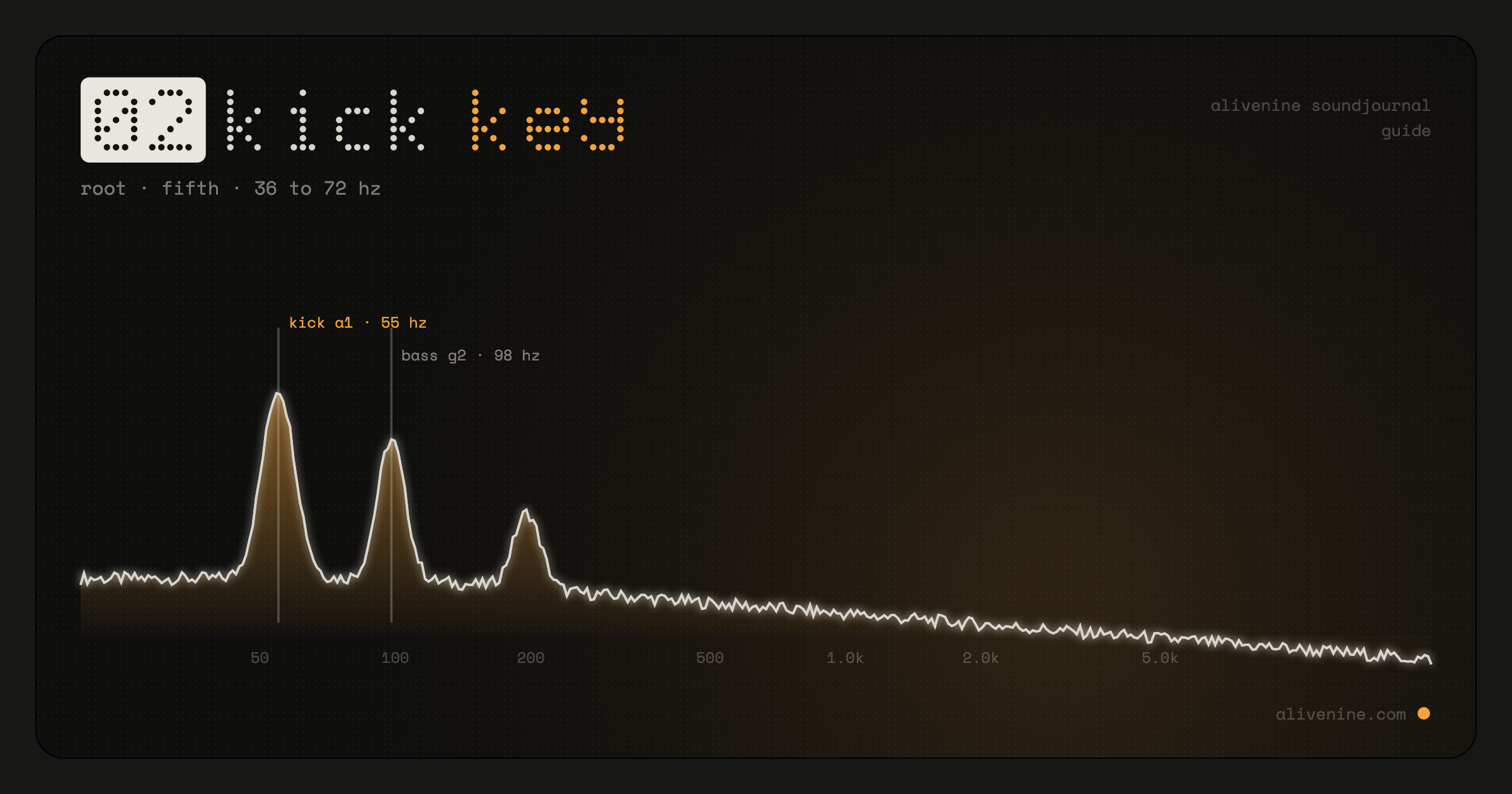
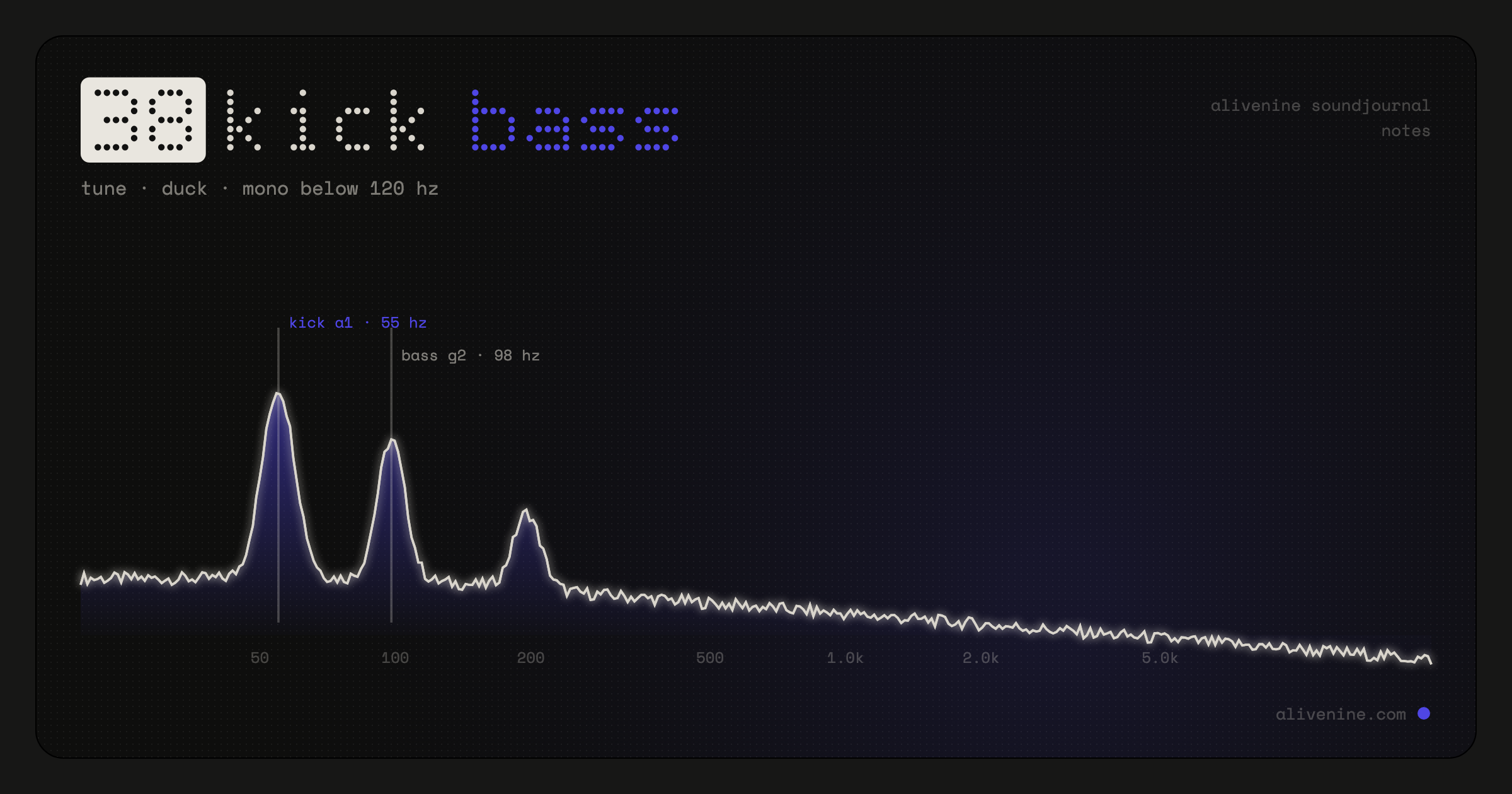
- tune the kick to the key and keep it a few semitones away from the bass notes that play with it. a semitone apart at 55 hz is a pulse of about 3 hz.
- duck only as much as you need: a compressor fed by the kick, a drawn volume curve, or ducking only the low band of the bass.
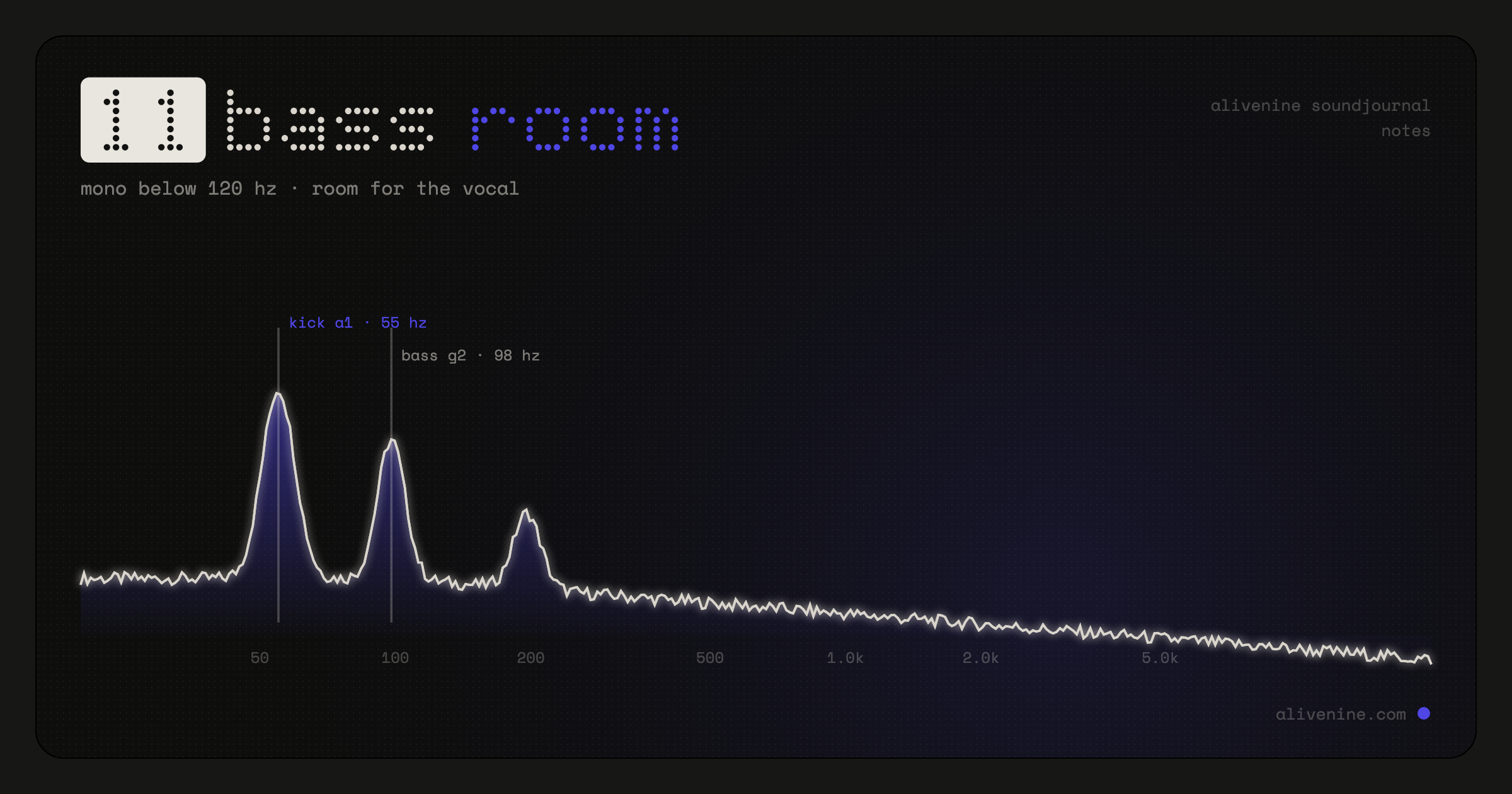
- keep everything below about 120 hz mono, and check the result on a phone before you trust it.
who owns which frequency
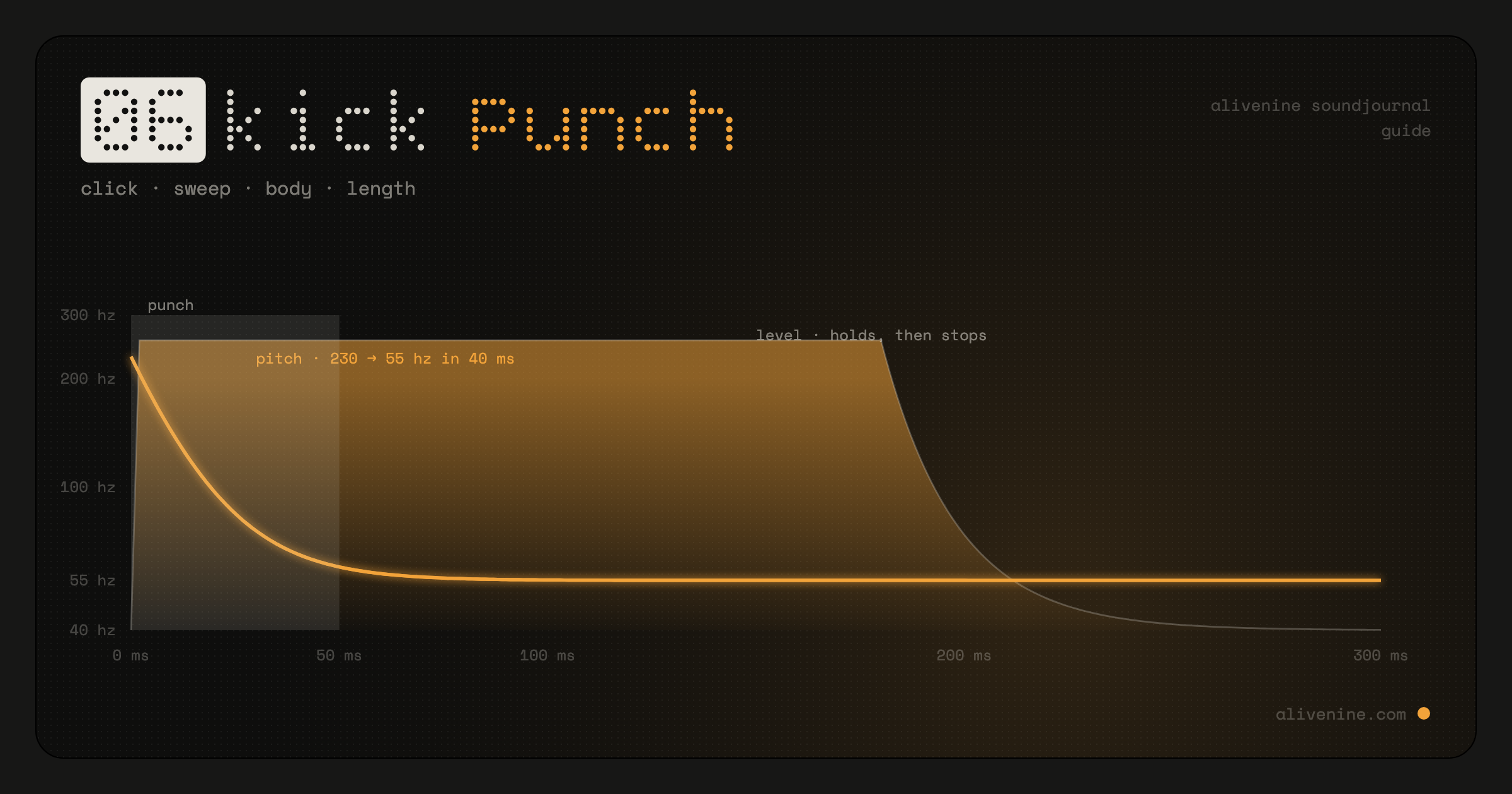
A kick is a short event: a click and a fast pitch sweep, then a body that rings for 150 to 300 ms in most house and techno. A bass is a sustained one: a note that holds, with overtones that carry it up into the mids. Both put their fundamental in the same place, roughly 40 to 80 Hz for the kick body and 40 to 120 Hz for the lowest bass notes.
We measured three finished songs band by band. The picture was the same in all three.
| Band | Share of the energy | Who lives there |
|---|---|---|
| Below 120 Hz | 40 to 70 % | Kick body, bass fundamental |
| 120 to 250 Hz | 16 to 21 % | Upper bass, low end of the snare |
| 250 to 500 Hz | 3 to 11 % | Body of the vocal, snare, guitars |
Kick and bass share the first band. The hole between 250 and 500 Hz is just as real: a kick with weight there sounds boxy, a bass that fills it pushes the vocal back.
So the first decision is ownership. One of the two owns the lowest octave at any moment. In a four on the floor track, that's usually the kick on the beat and the bass between the beats. In a track built on a long 808, it's the 808, and the kick turns into a short click or disappears.
tune both to the key
Every kick with a body has a note. If that note lands a semitone or two away from the bass note playing at the same time, the two low waves drift in and out of phase. You hear that as beating, a pulse as fast as the difference between the two frequencies.
| Kick | Bass | Apart | What you hear |
|---|---|---|---|
| A1, 55.0 Hz | A1, 55.0 Hz | 0 | No pulse, the two stack into one louder note |
| A1, 55.0 Hz | A#1, 58.3 Hz | 1 semitone | About 3.3 pulses a second, a slow wobble |
| A1, 55.0 Hz | B1, 61.7 Hz | 2 semitones | About 6.7 a second, a flutter |
| A1, 55.0 Hz | D2, 73.4 Hz | 5 semitones | 18 Hz apart, heard as two notes |
The same note isn't the goal either. It doesn't beat, but both add up in one narrow spot and the kick loses its outline. The comfortable zone is several semitones apart, with the kick on the root or the fifth of the key. How to find the note of a kick, measure it and retune a sample is all in how to tune your kick to the key of your track.
On the bass side, only the notes that fall on a kick or right after it matter. If the note under beat one sits a semitone from the kick, that bar wobbles on every system. Move that note, shorten the kick, or retune the kick for that section.
sidechain and volume shaping
Ducking turns the bass down for a moment every time the kick hits, so the kick gets the low end to itself. There are three common ways to do it, and they sound different.
a compressor with a sidechain input
A compressor on the bass, listening to the kick through its sidechain input. Every DAW has one. It follows the real kick, so it reacts to ghost notes and velocity.
- Attack: as fast as it goes, under 1 ms. A slower attack lets the start of the bass through, right on top of the hit.
- Release: tied to the tempo. At 124 BPM, a sixteenth is 121 ms and an eighth is 242 ms. The bass should be back by the next offbeat.
- Depth: 3 to 6 dB of gain reduction for a duck you feel more than hear. 10 dB and more is the pumping sound, and then it's a style choice.
- Ratio: 4:1 or more, with the threshold set so only the kick triggers it.
A compressor reacts only once the kick has started, so the first millisecond of the bass overlaps the hit. Lookahead fixes that, and so does a muted copy of the kick, nudged a few ms early and used only as the sidechain source.
a drawn volume curve
Volume shaping draws the duck instead of detecting it: a curve that drops at every beat and comes back, synced to the grid. The shape is exact and the same on every beat, and since it runs from the grid, it can start before the kick. A fill or a swung pattern still gets the same curve, so it suits four on the floor better than broken beats.
ducking only the low band
Both of the above turn down the whole bass, including the overtones that make it audible on small speakers. Split the bass at around 100 to 150 Hz and duck only the part below, and the line stays audible while the kick hits. A multiband compressor with a sidechain input does this, as does a dynamic EQ band on the low end keyed by the kick. Of the three, it sounds least like an effect.
| Method | Follows the real kick | Can start before the hit | Bass stays audible on a phone |
|---|---|---|---|
| Compressor, full band | Yes | With lookahead or a nudged trigger | No |
| Drawn volume curve | No, it follows the grid | Yes | No |
| Low band only | Yes | Depends on the tool | Yes |
who plays when
The cheapest fix happens before any plugin. If kick and bass don't start at the same moment, most of the clash never happens.
- Offbeat bass: kick on every beat, bass on the "and" in between. At 124 BPM the bass starts 242 ms after each kick, so a kick with a 200 ms body is gone before it arrives.
- Rest on the one: the bass skips the first sixteenth of each beat and comes in right behind the kick. It keeps the drive and frees the hit.
- Long 808, short kick: in sparse hip hop and trap, the 808 carries the low end and the kick is short and clicky, or gone. How to make an 808 and a reese bass covers that case.
- Long bass, short kick: when the bass holds long notes, give the kick about 150 ms and a quick fade, and the sustained note stays intact.
The end of each note matters as much as its start. A bass note that ends a sixteenth before the next kick often fixes more than any duck.
mono below 120 hz
A stereo difference in the low end mostly turns into cancellation. Two detuned oscillators or a chorus on a bass sound huge on headphones. Summed to mono on a club system or a phone, the low end comes and goes with the phase between left and right.
The finished songs we measured held only 1 to 5 percent side energy below 120 Hz. That's close enough to mono to treat it as the rule.
- Keep the kick and the low part of the bass in the center. If a sound is wide, split it and make only the part below about 120 Hz mono.
- Watch the correlation of the low band. If it drops toward zero or below, part of the low end disappears in mono.
phase between kick and bass
At 55 Hz, one cycle takes 18.2 ms. If the bass is half a cycle off against the kick body, 9.1 ms, the two cancel wherever they overlap instead of adding up. That's how two sounds that are fine on their own lose low end together.
- Layered kicks: if a sub layer under a punchy kick starts at a slightly different point, the body gets thinner when you add it. Flip the polarity of one layer, keep the louder version, then nudge by a millisecond or two.
- Bass and kick hitting together: a sine bass that starts at a random point in its cycle sounds slightly different on every hit, some fuller, some thinner. Many synths can restart the oscillator at zero on each note. For sub basses, that's usually what you want.
The quickest test is the polarity switch on the bass channel. Play kick and bass together and flip it. If the low end gets clearly louder in one position, they were fighting. If nothing changes, phase isn't your problem.
eq carving
EQ comes after the decisions above. Once ownership, notes, timing and mono are right, a few small moves finish the job.
- The owner's note: if the kick owns 50 to 60 Hz, a narrow dip of 2 to 4 dB in the bass at the kick's note gives it room. The reverse works too.
- 250 to 500 Hz: keep both lean here. It's the 3 to 11 percent hole from the table above. A kick with weight around 200 to 400 Hz sounds boxy, see how to make a kick drum punchy.
- The top of the bass: a steep low pass somewhere between 300 Hz and 1 kHz takes away space the bass doesn't need.
- The click: the kick owns 2 to 5 kHz. A bright bass attack in the same place smears the hit.
A dynamic EQ band on the bass, keyed by the kick, combines dip and duck: it cuts only at the kick's note and only while the kick plays.
checking on small speakers
A phone speaker plays very little below 200 Hz. On the speakers most people use, the kick body and the bass fundamental are close to silent. What's left is the click of the kick and the overtones of the bass, and the ear fills in the low note from them, an effect called the missing fundamental.
- Listen in mono with everything below 200 Hz removed. If the kick turns into nothing, it needs more click around 3 to 5 kHz, not more body.
- If the bassline disappears, it needs overtones between about 200 and 600 Hz. Saturation on the upper part, or a few clean harmonics of the root, brings it back without touching the low end.
- Check the duck there too. A full band duck that's fine on monitors can make the bass blink on a phone, because the only part you hear dips on every beat.
common tools for the job
The stock devices in every DAW cover the whole list. Third party tools mostly make one step faster or easier to see.
| Step | Stock tool | What a dedicated tool adds |
|---|---|---|
| Tuning | A tuner, or a spectrum that shows notes | Reading the note of a kick from its tail |
| Ducking | The compressor's sidechain input in Ableton Live, Logic Pro and most other DAWs | Volume shapers draw the curve, trigger it from MIDI or audio and offer lookahead |
| Low band ducking | A multiband compressor with sidechain | Dynamic EQ that ducks only where the kick is |
| Mono low end | Ableton's utility has a bass mono switch with an adjustable frequency | Stereo imagers with a mono crossover and per band correlation |
| Phase | The polarity switch and the track delay | Alignment plugins that find the best offset between two tracks |
A volume shaper is the fastest way to a consistent duck in four on the floor, and a dynamic EQ the most transparent way to share a note. None of them fixes a kick and a bass a semitone apart on the same beat. That part is always arrangement and tuning.
how alivebass and alivedrum handle it
I built both so that most of the steps above are already done when you load them. You can still change every one of them.
alivebass
alivebass splits every bass at 120 Hz behind the oscillators. The part below is always mono. The part above is stereo and gets its own treatment, chorus and echo included, so the width never reaches the low end.
The low half ducks for the kick. Put the kick on the sidechain input, or let it duck on every beat of the grid without any routing. At full depth, the low band drops by up to 92 percent of its level, about 22 dB, while the upper band dips by only 35 percent. The detector reacts within 0.6 ms and lets go over about 110 ms. The window shows how much it's ducking, along with the correlation per band.
With mix fit on, a 24 dB per octave low pass sits on everything above 120 Hz, between 300 and 950 Hz depending on the world. A phone setting adds the 2nd to 6th harmonic of the root, up to 600 Hz, and the phone check in the header plays the result in mono with everything below 200 Hz removed. More on the mix side is in a bass that leaves room for the kick and the vocal.
alivedrum
alivedrum is a drum synth with no samples, and its kick is tuned before you touch it. Set a key and a scale, and the kick body lands on a note of that key: between 49 and 58 Hz in the sub range, G1 to A#1, or between 58 and 70 Hz in the punch range. It prefers the root, then the fifth, then the fourth, close to the middle of the range. tune moves it from there.
Then there's bass follow. alivedrum reads your bass from MIDI notes on channel 2, or from the bass track on its sidechain input, where it detects the pitch between 28 and 350 Hz. When it knows the bass note, the kick moves to the note of the key in its range that sits furthest from it, counting distance up to 5 semitones, with root and fifth still preferred. It only takes a new note once it has been stable for 150 ms, and on the sidechain it holds the last bass note through gaps of up to 0.8 seconds, so the kick doesn't jump on every pause in the line.
The kick also stays out of the hole. The offline test fails any kit whose sub kick puts more than 12 percent of its energy between 100 and 500 Hz. You can play alivedrum in the browser with the real plugin code.
faq
Why do my kick and bass clash?
Usually they hit at the same moment on notes a semitone or two apart, so they beat against each other. The bass can also be loud in the first 50 ms after each kick and cover the hit. And sometimes part of the low end is stereo or out of phase and cancels in mono.
Should kick and bass be in the same key?
Yes. The kick body has a note, and in the key it fits the chords and the bassline. Root or fifth are the safest choices. What matters most is the distance to the bass notes on or right after the kick: a few semitones apart works, a semitone apart wobbles.
How much should I sidechain the bass to the kick?
3 to 6 dB of gain reduction is enough for most mixes, with the fastest attack and a release that brings the bass back by the next offbeat, about 120 to 240 ms at 124 BPM. More than 10 dB is the audible pumping sound.
Should bass be mono?
The part below about 120 Hz should be. The finished songs we measured had only 1 to 5 percent side energy there. Above that, a bass can be as wide as you like.
How do I check kick and bass on small speakers?
Listen in mono with everything below 200 Hz cut, the way a phone plays it. You should still hear the click of the kick and the line of the bass. If either disappears, add click to the kick or overtones to the bass.
Get the notes and the timing right first, then duck and carve only as much as you need. Play alivebass in the browser with a kick on the sidechain, or get it in the shop. For the kick side, how to tune your kick to the key of your track is the next step.