· by max
how to make an 808 and a reese bass
The 808 and the reese are the two basses most people ask about, and they work in opposite ways. An 808 is almost nothing: one sine wave that drops into its note and rings out for a long time. A reese is all movement: two saw waves, a few cents apart, rolling against each other until the low end seems to breathe. Both are easy to build in any synth once you know the handful of settings that matter. Below are both, step by step, with the numbers, and what to do so they still work next to a kick and on a phone speaker.
- an 808 is a sine with a fast pitch drop at the start and a long decay. the tuning matters more than the sound, because the long tail holds one clear note.
- glide between notes is what turns an 808 into a line. 50 to 150 ms is the usual range.
- a pure sine below 60 hz is nearly silent on a phone. saturation adds overtones that the ear reads as the missing bass.
- a reese is two saws detuned against each other. the beating gets faster with every overtone, so you hear the roll in the upper part, not in the fundamental.
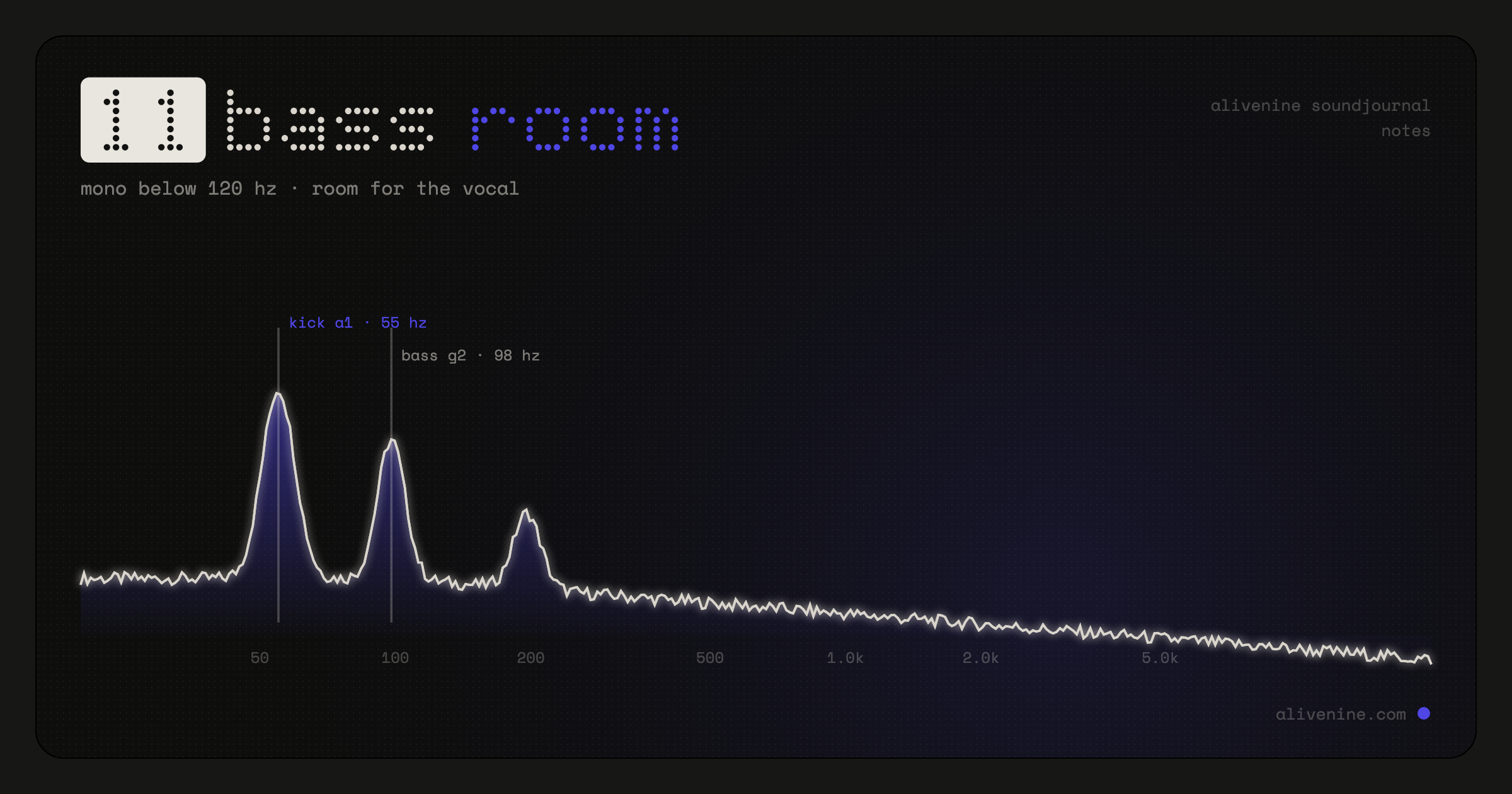
- keep both mono below about 120 hz and give the kick its own moment, by note, by timing or by ducking.
two basses, two ideas
The name 808 comes from the TR-808 drum machine, released in 1980. Its bass drum was a decaying sine, and producers learned to tune it, stretch its decay and play it as a bass. Today an 808 means that sound, wherever it comes from: a long, round, sub heavy note with a short knock at the start.
The reese goes back to a Detroit techno record from the late eighties and became the backbone of drum and bass. It is the opposite of the 808. Where the 808 is one clean wave, the reese is two rough ones that never quite agree.
| 808 | Reese | |
|---|---|---|
| Source | One sine | Two saws, detuned |
| Movement | Pitch drop at the start, then still | Constant beating, filter motion |
| Envelope | Fast attack, long decay, no sustain | Held, sustain high |
| Where the energy sits | Almost all in the fundamental | Fundamental plus a lot of overtones |
| Typical styles | Trap, hip hop, drill, grime, pop | Drum and bass, garage, techno, dubstep |
| Main risk in the mix | Wrong note, inaudible on phones | Muddy low end, too wide below |
the 808, step by step
Any synth with a sine oscillator, an amp envelope and a pitch envelope can do this. A sampler with a single 808 hit works too, as long as you can tune it and change its decay.
- Oscillator: a single sine. Turn off any second oscillator, noise and sub. The sine is the whole sound.
- Filter: open, or off. A sine has no overtones for a filter to remove.
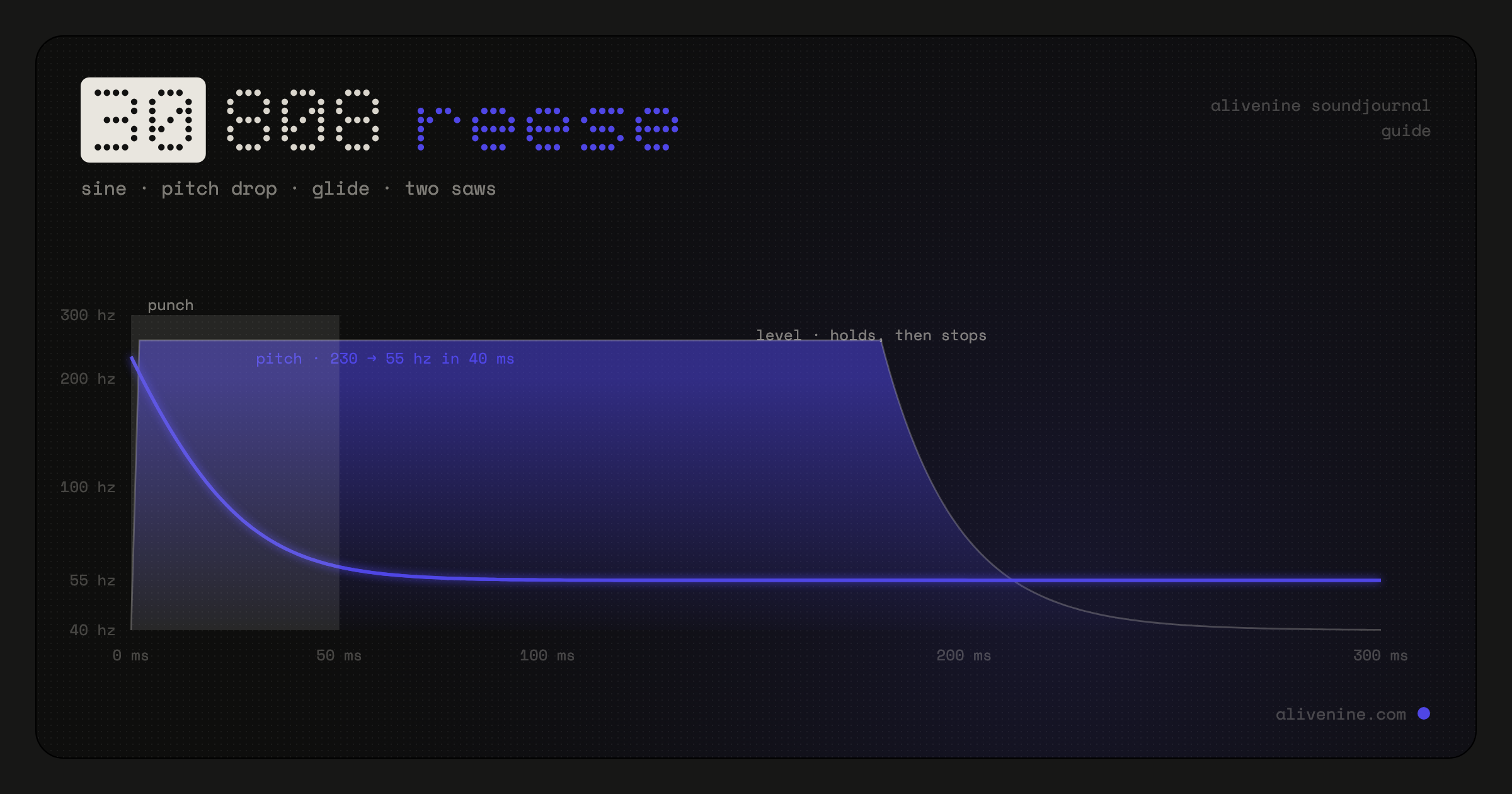
- Amp envelope: attack 0 to 2 ms, decay 1 to 3 seconds, sustain 0, release short. With sustain at 0 the note fades on its own even if you hold the key, which is what an 808 does.
- Pitch envelope: route an envelope to pitch with an amount of 12 to 24 semitones, attack 0 and a decay of 20 to 60 ms. The note starts one or two octaves above and falls into place. This is the knock you hear at the start.
- Mono and glide: set the voice to mono, legato if your synth has it, and add a little glide. More on that below.
- Level: leave headroom. A long sine at full level eats a lot of the meter.
The pitch drop is the part most people overdo. A long drop sounds like a laser. A short one, under 50 ms, is heard as attack, not as a pitch change. Try 12 semitones over 30 ms first, then move one value at a time.
tuning the 808
Because an 808 rings for seconds, it is heard as a note, and a wrong note in the bass makes the whole track sound off. Three things decide whether it is in tune.
the note itself
If you work with a sample, find its root first. A tuner plugin on the channel shows it, or you play the sample against a sine at the root of your key and listen for beating. If you build it in a synth, it already plays the note you press.
the register
Most 808s sit with their main notes roughly between 35 and 65 Hz. E1 is 41.2 Hz, F1 43.7 Hz, G1 49.0 Hz, A1 55.0 Hz. Below about 30 Hz there is little left that speakers can play and that the ear hears as pitch. Above about 80 Hz the 808 starts to compete with the body of the kick and the low mids.
| Note | Hz | Note | Hz |
|---|---|---|---|
| C1 | 32.7 | G1 | 49.0 |
| D1 | 36.7 | A1 | 55.0 |
| E1 | 41.2 | B1 | 61.7 |
| F1 | 43.7 | C2 | 65.4 |
the pitch drop
With a long pitch drop, the note you hear in the first 50 ms is above the note you play. That's fine. What the ear holds on to is where it lands. Just check by ear that the landing note and the key agree, especially when you change the drop amount.
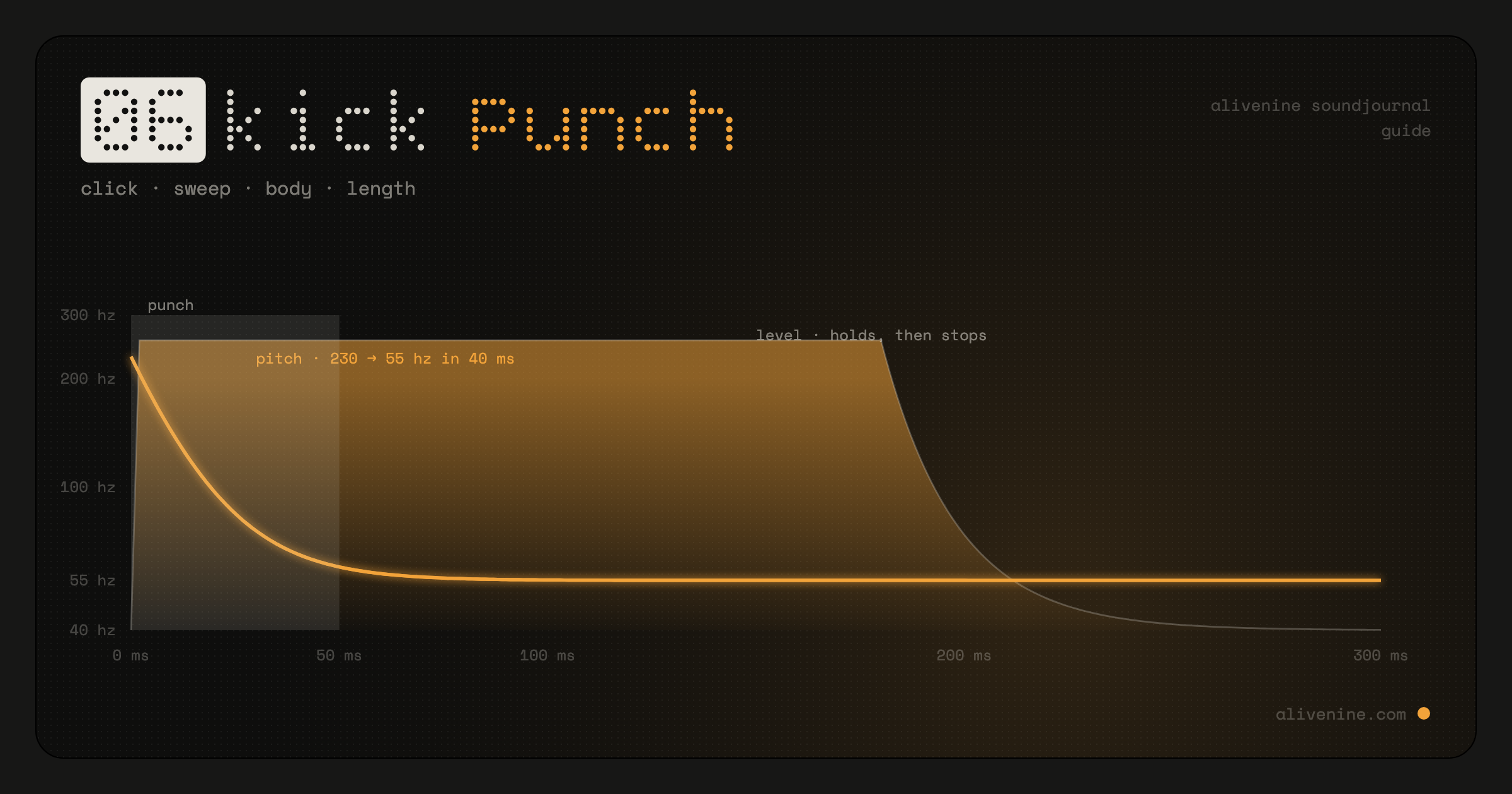
The same idea applied to the kick is in how to tune your kick to the key of your track.
glide and slides
Glide, or portamento, lets the pitch slide from one note to the next instead of jumping. It's what makes 808 lines sound sung.
- Mono and legato: glide only happens when notes overlap. In most synths you set the voice to mono and turn on legato, then let the next note start before the previous one ends.
- Time: 50 to 150 ms is the usual range. Under 40 ms it's barely heard. Over 200 ms it becomes an effect.
- Which notes: slide into the octave above on the last beat of a bar, or down a fifth into the next bar. Slide on two or three notes in a phrase, not on every note.
- Slides by hand: if your synth has no glide, draw a pitch bend into the MIDI clip. Set the bend range to 12 semitones so one full bend is an octave.
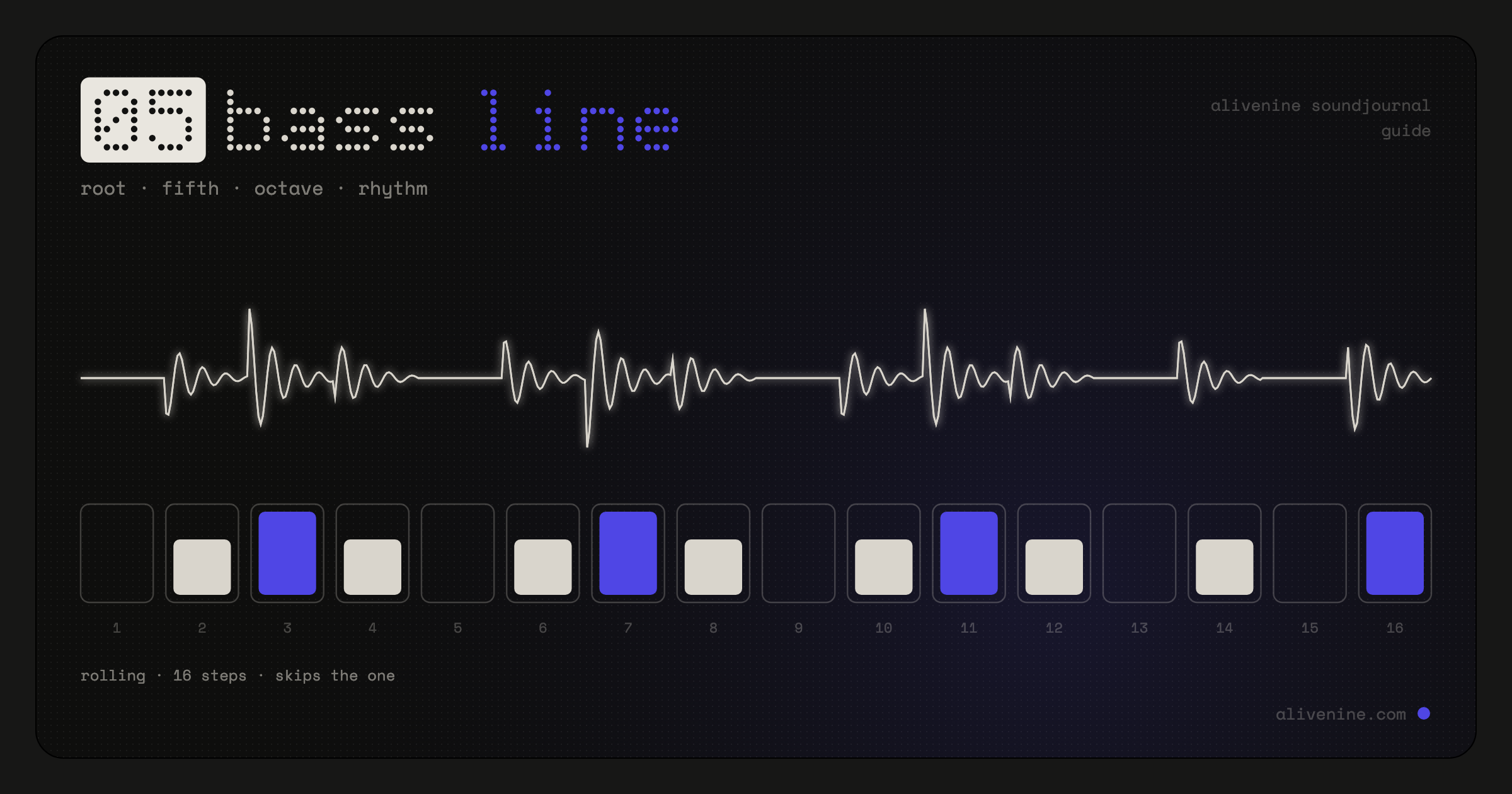
The rhythm of the line matters as much as the slides. Long notes with space between them suit the 808, because every gap lets the next note start with its knock. How to make a bassline goes through rhythms that lock with the kick.
making it audible on small speakers
A sine at 41 Hz has no overtones. A phone speaker plays very little below 150 to 200 Hz, laptop speakers not much more. So a clean 808 can be loud on a club system and almost gone on a phone. The fix is to give it overtones, harmonics at 2, 3, 4 times the note, which small speakers can play. The ear hears them and fills in the missing fundamental.
- Saturation or distortion on the 808 is the classic way. Soft saturation adds mostly low harmonics and keeps the sound round. Harder clipping adds more and sounds aggressive.
- Blend, don't replace: if the low end gets smaller with distortion, use the effect in parallel or with a mix control, so the clean sine stays underneath.
- Check mono and small: listen in mono with everything below 200 Hz removed. If you still hear the line and its rhythm, it will work on phones.
A limiter or clipper at the end of the chain helps too. 808 peaks are big and short, and catching them gives the rest of the mix room.
808 and kick together
An 808 and a kick both live in the same few octaves. If they hit at the same moment, on different notes, they beat against each other and the low end turns into a wobble. There are four ways out, and most tracks use two of them at once.
| Approach | How | When it fits |
|---|---|---|
| No separate kick | The 808 is the kick: short knock, long tail | Sparse beats, trap, minimal hip hop |
| Kick takes the attack | Short, clicky kick, 808 with a softer start | When both hit together often |
| Different moments | 808 notes between the kicks | Bouncy lines, garage, drill |
| Ducking | Sidechain the 808 to the kick for 50 to 150 ms | Four to the floor, dense patterns |
Tuning the kick to the same note as the 808, or to its fifth, removes most of the beating when they do meet. How to make a kick drum punchy covers the kick side of this.
the reese, step by step
A reese needs two oscillators with saw waves and a filter. Every subtractive synth has that.
- Oscillators: two saws, same octave, same level.
- Detune: tune one up and one down by the same amount, 10 to 30 cents each. More detune means faster rolling.
- Filter: low pass, cutoff around 400 to 1000 Hz, a little resonance. The filter decides how much of the rough top you hear.
- Amp envelope: attack a few ms, sustain high, release short. A reese is held, not plucked.
- Mono: one voice, a little glide if you want slides.
- Movement: slowly move the cutoff with an LFO or by hand, over one or two bars. A reese that stands still gets tiring.
- Grit: soft distortion before or after the filter makes it heavier. After the filter it stays brighter.
A sub sine an octave below under the saws keeps the lowest note steady while the saws roll above it. Many reese sounds in drum and bass are built exactly like that, with the saws filtered out below 100 Hz or so.
why a reese rolls
Two tones a little apart in pitch go in and out of phase. When they line up, they add. When they're opposed, they cancel. The result is a volume pulse, called beating, whose rate is the difference between the two frequencies.
At a low note, that difference is tiny. Two saws at E1, 41.2 Hz, each detuned 21 cents in opposite directions, are 42 cents apart. That's 41.2 × (242/1200 − 1), about 1 Hz: one slow swell per second.
A saw has overtones at every multiple of its note, and each pair of overtones beats too, faster by the same factor. The second harmonic pulses twice per second, the fifth five times, the tenth ten times, all at once. That's why the roll of a reese lives in the upper part of the sound. Close the filter and it calms down. Open it and it gets restless.
| Detune per saw | Apart | Beating at E1 (41.2 Hz) | At A1 (55 Hz) | 10th harmonic at E1 |
|---|---|---|---|---|
| 6 cents | 12 cents | 0.29 per second | 0.38 | 2.9 |
| 10 cents | 20 cents | 0.48 | 0.64 | 4.8 |
| 21 cents | 42 cents | 1.0 | 1.4 | 10 |
| 36 cents | 72 cents | 1.8 | 2.3 | 18 |
This also means the same detune sounds busier on higher notes. If a reese feels calm at E1 and frantic an octave up, that's the math, and you can lower the detune for the higher parts.
mono below, wide above
A reese invites stereo: pan one saw left and one right and it gets huge on headphones. The problem is the low end. Below about 120 Hz, two detuned saws on two sides cancel each other in mono every time they're out of phase. On a club system or a phone, the bass then comes and goes.
- Keep everything below about 120 Hz mono and centered, the sub, the 808, the low part of the reese.
- Make only the upper part wide, with panning, chorus or a widener on a high passed copy.
- Check in mono often. If the bass loses weight or starts pumping in mono, the stereo goes too low.
More on how much room a bass needs, and where to leave space for the vocal, is in a bass that leaves room for the kick and the vocal.
both in alivebass
alivebass is the bass synth I built, and both of these are in it as their own worlds. Picking a world sets everything at once, and from there you keep turning.
- 808: the oscillator is a pure sine. punch drops the pitch at the start, from 0 to 24 semitones, and falls within a few dozen milliseconds. The 808 world starts with punch at 12 semitones, a decay of 2.5 seconds, no sustain and a short glide, and without the sequencer, so you play it.
- Reese: two saws detuned against each other, each by 6 to 36 cents depending on width, and slightly crossed between left and right. width sets how fast it rolls.
- glide slides from the last note in mono, also between the steps of the sequencer. slide in and slide out let a note rise into its pitch or fall away when you let go.
- sub adds a sine one octave down, always mono in the middle. On the 808 oscillator it's left out, because the sine is already the sub.
- A crossover at 120 Hz keeps the low part mono and lets it duck for the kick, from a sidechain or on every beat. Above it, the bass can be wide.
- phone adds clean overtones from the root, the 2nd to the 6th, up to 600 Hz, so the line is heard on small speakers. phone check lets you listen the way a phone plays it: mono, with everything below 200 Hz removed.
- drive has six kinds of distortion, from round tape to hard clip. mix fit tames the bass for the mix with a ceiling and two dips that leave room for the vocal.
You can play both worlds in the browser on the alivebass page, with the real plugin code.
faq
How do you make an 808 bass from scratch?
Use a single sine oscillator, set the amp envelope to a fast attack, a decay of 1 to 3 seconds and no sustain, and add a pitch envelope of 12 to 24 semitones that falls within 20 to 60 ms. Set the voice to mono with a little glide, then add saturation so it's heard on small speakers.
What key should my 808 be in?
The same key as the track. The 808 rings long enough to be heard as a note, so it should play the root and the notes of the chords. If you use a sample, find its root with a tuner and transpose it to fit.
Why can't I hear my 808 on my phone?
Phone speakers play very little below 150 to 200 Hz, and a clean 808 has almost all its energy far below that. Saturation or distortion adds overtones that the phone can play, and the ear fills in the missing low note.
What is a reese bass?
A bass made from two saw waves detuned against each other. The small difference in pitch makes them beat, so the sound rolls and breathes. It's filtered, often distorted, and common in drum and bass, garage and techno.
How much detune for a reese?
10 to 30 cents per oscillator, in opposite directions, is a good range. Less sounds almost static, more rolls faster. The same detune rolls faster on higher notes, because the beating scales with frequency.
Should bass be mono?
Below about 120 Hz, yes. Stereo in the lowest octaves cancels in mono and weakens the bass on club systems and phones. Keep the low part centered and make only the upper part wide.
The quickest way to hear all of this is to switch between the 808 and reese worlds on alivebass and play the same note in both.